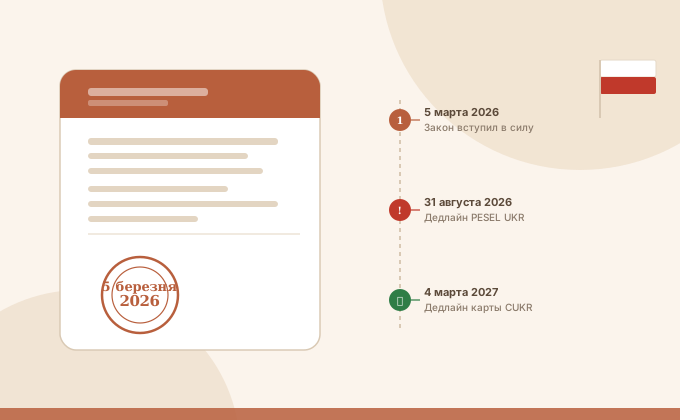
"Protection was extended to 2028 — so my card is valid to 2028 too." That is the most common misreading of autumn 2026, and it is an expensive one.
These are two different deadlines. They coincided for eighteen months and parted ways on 5 August 2026.
| What | Until | Set by |
|---|---|---|
| EU temporary protection | 4 March 2028 | Council Implementing Decision (EU) 2026/1912 of 30 July 2026, in force from 05.08.2026 |
| Polish deadlines for visas, cards and permits | 4 March 2027 | The wind-down act (Dz.U. 2026 item 203), in force from 05.03.2026 |
The gap is exactly one year. Below: where it came from, who it affects, and which of the old rules stopped applying altogether.
What was repealed on 5 March 2026
The act of 23 January 2026 winding down the solutions arising from the act on assistance to Ukrainian citizens (Dz.U. 2026 item 203) entered into force on 5 March 2026. It repealed four provisions of the special act:
| Provision | What it gave | Now |
|---|---|---|
art. 42(6) |
Extended to 04.03.2026 the deadline to comply with the obligation to leave under art. 299(6) of the act on foreigners |
Repealed; the general deadline applies |
art. 42(7) |
Extended to 04.03.2026 the voluntary departure period set in a return decision (art. 315(1)) |
Repealed |
art. 42a(1) |
Allowed a one-off special permit for 1 year or 6 months to a Ukrainian citizen even where the normal conditions were not met | Repealed |
art. 42b |
Allowed the Border Guard not to open, or to discontinue, return proceedings | Repealed |
The most significant loss is art. 42a(1). It was a cushion: if an applicant fell short of the conditions for their chosen ground, the voivode could still issue a one-year permit. 4 March 2026 was the last day it could be applied. From 5 March the ordinary requirements and the ordinary refusal grounds of the act on foreigners apply in full.
One reassuring caveat: decisions already issued under art. 42a(1) remain in force. Repealing the provision does not cancel the permits granted under it.
What was extended to 4 March 2027
The same act extended five categories of deadline. All of them concern documents that expired, or expire, from 24 February 2022 onwards:
| Provision | What is extended to 04.03.2027 |
|---|---|
art. 42(3a) |
The stay period under national visas and the validity of those visas |
art. 42(5a) |
The validity of temporary residence permits |
art. 42(8) |
The validity of residence cards, Polish identity documents for foreigners, and zgoda na pobyt tolerowany documents |
art. 42(11) |
The period treated as lawful stay for those who used up their allowance under a Schengen visa, under a visa or residence document of another Schengen state, or visa-free |
art. 42(12a) |
The period during which the requirement of art. 142(1)(3) on the scale and quality of business activity does not apply to a Ukrainian citizen trading through CEIDG |
The last row deserves attention because it is barely discussed. A business-based residence permit normally requires last year's income, or two employees, or funds for the future (covered in our article on residence permits for freelancers). For Ukrainian citizens with a sole proprietorship that requirement simply does not apply until 4 March 2027. It is a concession with an expiry date.
Where the one-year gap came from
Now the part worth reading to the end.
Why do the Polish deadlines end precisely on 4 March 2027? The Office for Foreigners answers this directly: the act extended them to that date, "a zatem do dnia, w którym aktualnie istnieje perspektywa trwania ochrony czasowej" — that is, to the day up to which, at that time, temporary protection was expected to run.
In January 2026, when the act was passed, EU protection did indeed run to 4 March 2027. The Polish legislature simply pinned itself to that horizon.
Then on 30 July 2026 the Council adopted Implementing Decision (EU) 2026/1912, and from 5 August protection was extended by another year — to 4 March 2028.
The Polish deadlines did not follow. They are fixed in the statute as a specific date rather than tied to the Council decision, and moving them requires a fresh amendment.
| EU protection | Polish deadlines | |
|---|---|---|
| Before 05.08.2026 | 04.03.2027 | 04.03.2027 |
| After 05.08.2026 | 04.03.2028 | 04.03.2027 |
What this means in practice. Someone with UKR status whose residence card was extended by statute rather than by a voivode's decision will find, on 5 March 2027, that their EU protection still exists while their Polish document has expired. These are different things: protection gives you the status, the card is the document that proves it at the border, to an employer and at a bank.
We are not claiming the gap will remain. It is more likely that an amendment aligning the Polish dates with the European ones will appear before March 2027 — that is exactly what happened on previous occasions. But until it does, plan from 4 March 2027, not from 2028. This is the kind of miscalculation you discover on the day it is already too late.
What protection holders can apply for: art. 45 replaces art. 42(13)–(19)
One more change that is easy to miss because it looks technical.
As a general rule, art. 99(1)(4) of the act on foreigners means a person benefiting from temporary protection is refused an opening of proceedings on a temporary residence application. There is an exception, and it used to live in art. 42(13)–(19) of the special act.
From 5 March 2026 those provisions were replaced by art. 45 of the wind-down act. The substance of the exception is preserved: a holder of a PESEL with UKR status may apply for five types of permit:
| Permit type | Provision |
|---|---|
| Single permit for residence and work | art. 114 of the act on foreigners |
| Blue Card — work in a profession requiring high qualifications | art. 127 |
| Residence permit for business activity | art. 142(1) or (3) |
| Residence permit for a family member of a Polish citizen | art. 158(1) |
| Residence permit for family reunification | art. 159(1) |
The practical point: UKR status does not lock you inside temporary protection. There are five routes out to an ordinary permit, and this is not the voivode's goodwill but a provision with an address. If you were refused an opening of proceedings citing art. 99(1)(4) while applying on one of these five grounds, that refusal is worth showing to a lawyer.
What is in this article and what is not
So you do not look here for what is covered elsewhere:
| Topic | Where |
|---|---|
| The CUKR card: conditions, procedure, myths, refusals | The CUKR Card: Myths and Facts |
| Protection extended to 4 March 2028 and the military-obligation condition | EU Temporary Protection Extended to 4 March 2028 |
| The deadline to confirm identity for PESEL UKR | PESEL UKR: Confirm Your Identity by 31 August 2026 |
| Why case processing deadlines are frozen | Poland's Residence Deadline Freeze: art. 100d in Court |
| What happens if you miss the filing deadline | Missed the Residence Card Deadline: What You Really Lose |
Here: only the wind-down act itself — what it repealed, what it extended, and until when.
Not sure whether your card was extended by statute or expires on its own terms? In a free consultation we'll go through your situation and work out the dates you should actually be planning from.
Frequently asked questions
Protection runs to 2028. Is my residence card valid to 2028 too?
No, not if its validity was extended by statute rather than by a voivode's decision. The extension under art. 42(8) runs to 4 March 2027. EU protection under decision 2026/1912 runs to 4 March 2028. Two different deadlines, and since 5 August 2026 they no longer coincide.
What happens on 5 March 2027? Under the statute as it currently stands, the extension of Polish documents ends that day. An amendment aligning the dates will most likely appear before then — it has before. But plan against the provision in force, not the one you expect.
I already hold a permit issued under art. 42a(1). Will it be cancelled?
No. The provision was repealed on 5 March 2026, but decisions issued under it remain in force. A repeal operates for the future, not retroactively.
I have a sole proprietorship and UKR status. Is it true I don't have to show income for a business permit?
Until 4 March 2027 the requirement of art. 142(1)(3) on the scale and quality of the activity does not apply to you — that is what art. 42(12a) says. The other conditions still do. After that date the concession ends unless it is extended.
I was refused an opening of proceedings because of my temporary protection. Is that lawful?
It depends on which ground you applied under. Art. 99(1)(4) does bar opening a case for a protection beneficiary, but art. 45 of the wind-down act creates an exception for five permit types: the single residence-and-work permit, the Blue Card, business activity, family member of a Polish citizen, and family reunification. If you applied under one of those, the refusal is worth checking.
Can I still get a permit without meeting the normal requirements?
No. The provision that allowed it (art. 42a(1)) has been repealed, and its last day of application was 4 March 2026. From 5 March the ordinary requirements and refusal grounds of the act on foreigners apply.

Comments