
Is the 12% lump-sum rate really the cheapest option?
No. And it's the most expensive mistake made at registration, because the taxation form is chosen once and generally cannot be changed mid-year.
People compare the 12% rate against the 19% flat tax and conclude that 12 is less than 19. But the two aren't comparable: the lump sum (ryczałt) is charged on turnover, while the flat tax is charged on profit. Under the lump sum, costs are not deductible at all — not rent, not equipment, not subcontractors, not your accountant.
Here is what that produces at the same turnover of 400,000 PLN a year:
| Lump sum 12% | Flat tax 19% | |
|---|---|---|
| Costs of 50,000 PLN (profit 350,000) | tax 48,000 + health 17,940 = 65,940 PLN | tax 66,500 + health 17,150 = 83,650 PLN |
| Costs of 250,000 PLN (profit 150,000) | tax 48,000 + health 17,940 = 65,940 PLN | tax 28,500 + health 7,350 = 35,850 PLN |
Note the left-hand column: it doesn't change. The turnover is the same, so the tax and the health contribution are the same, however much you spend. On the right, the gap is nearly 48,000 PLN.
The conclusion is simple: with low costs the lump sum usually wins; with high costs it loses, and loses heavily. The headline rate decides nothing on its own.
Simplified calculation: it ignores the health-contribution deduction (up to 14,100 PLN under the flat tax in 2026; 50% of the amount paid under the lump sum) and social contributions. These shift the figures but not the direction of the conclusion.
What the lump sum, the scale and the flat tax actually are
If you're only now opening a JDG, all three names sound equally opaque. The difference between them is single and simple: what the tax is charged on.
Ryczałt (in full, ryczałt od przychodów ewidencjonowanych — a lump sum on recorded turnover). The tax is charged on everything you were paid, before any deduction of costs. The rate depends on what you do: from 3% to 17%.
You earn 10,000 PLN and spend 4,000 on equipment — the tax is still calculated on 10,000.
Upside: low rates, simple record-keeping. Downside: costs don't reduce the tax at all.
Skala podatkowa (the tax scale, also called zasady ogólne — the general rules). The tax is charged on profit: income minus costs. The rate rises with earnings — 12% on profit up to 120,000 PLN a year, 32% on anything above. There's a tax-free allowance of 30,000 PLN a year.
You earn 10,000 PLN and spend 4,000 — the tax is calculated on 6,000.
Upside: costs are deductible, there's a tax-free allowance, and you can file jointly with a spouse. Downside: past 120,000 PLN the rate jumps sharply.
Podatek liniowy (the flat tax). Also charged on profit, but at a single rate whatever you earn — 19%, however much that is.
The same 6,000 of profit — 19%. And on 600,000 of profit — still 19%.
Upside: predictability; it pays off at high profit. Downside: no tax-free allowance and no joint filing with a spouse.
From here on the article uses these names as they stand — that's exactly how they appear on the forms you'll be filling in.
What regimes exist?
| Regime | Charged on | Rate | Costs deductible? |
|---|---|---|---|
| Lump sum (ryczałt od przychodów ewidencjonowanych) | Turnover (przychód) | By PKD code: 2%, 3%, 5.5%, 8.5%, 10%, 12%, 12.5%, 14%, 15%, 17% | No |
| Progressive scale (skala podatkowa) | Profit (dochód) | 12% up to 120,000 PLN, 32% above | Yes |
| Flat tax (podatek liniowy) | Profit (dochód) | 19% at any level of income | Yes |
Your PKD code is chosen at registration, but the rate is set not by that code — it's set by the PKWiU classification of what you actually do. An imprecise primary code later turns into an argument with the tax office about which rate you should have been paying all along.
What rate applies to your profession
The rate is determined not by your job title but by the PKWiU classification of what you actually do. That said, the reference points for the most common professions look like this:
| Profession | Rate | Provision and PKWiU |
|---|---|---|
| Programmer, developer | 12% | pkt 2b lit. b — ex 62.01.1 |
| Business analyst in IT | 12% | pkt 2b lit. b — ex 62.02 |
| System administrator, DevOps, IT systems management | 12% | pkt 2b lit. b — 62.03.1 |
| Project manager (operational delivery) | 8.5% | pkt 5 lit. a — 70.22.20.0 |
| Marketing, advertising, market research | 15% | pkt 2 lit. o — division 73 |
| Data processing | 15% | pkt 2 lit. i — ex 63.11.1 |
| Recruiter, employment services | 15% | pkt 2 lit. s — division 78 |
| Photographer | 15% | pkt 2 lit. q — 74.2 |
| Management consultancy | 15% | pkt 2 lit. m — ex division 70 |
| Doctor, dentist, nurse, physiotherapist | 14% | pkt 2a lit. a — division 86 |
| Architect, engineer, technical testing | 14% | pkt 2a lit. b — division 71 |
| Designer (specialist design services) | 14% | pkt 2a lit. c — 74.1 |
| Translator | 17% as a liberal profession, otherwise 15% | pkt 1 or pkt 2 lit. r — 74.3 |
| Lawyer, accountant, tax adviser | 17% as a liberal profession, otherwise 15% | pkt 1 or pkt 2 lit. l — division 69 |
| Tutor, teacher | 8.5% | pkt 5 lit. c — division 85 |
| Construction, manufacturing, freight over 2 tonnes | 5.5% | pkt 6 lit. a |
| Retail, catering | 3% | pkt 7 lit. a, b |
| Anything not named separately | 8.5% | pkt 5 lit. a — the residual rate |
A note on the 17% "liberal professions". Art. 4 ust. 1 pkt 11 sets them out as a closed list: translators, advocates, notaries, legal advisers, statutory auditors, accountants, insurance agents and brokers, tax and restructuring advisers, securities brokers, investment advisers, patent attorneys. Doctors are not on that list — they fall under 14%.
And an important detail from the same provision: a profession counts as liberal only where it is practised personally, without employing people who perform the core work of that same profession — whether on an employment contract, a zlecenie, an o dzieło or anything similar. Hire a second lawyer into the practice and the rate changes.
Three grey zones with no settled answer:
- QA tester — could fall under 12% as software-related services, or into the residual 8.5%, depending on how closely the work is bound to the software itself.
- UX/UI designer — 14% as "specialist design services" (PKWiU 74.1), or 12% as software-related services.
- Any role with "consultant" in the contract — a risk of drifting into 15% under
lit. m, even where you don't in fact advise on management.
In these cases it's worth obtaining the classification from GUS first, and then, if needed, an individual interpretation from KIS.
The management contract: the lump sum doesn't reach it
A separate case that catches out management-level clients regularly — and the cost of getting it wrong is above average.
Art. 13(9) of the PIT Act classifies the following as działalność wykonywana osobiście, personally performed activity:
"przychody uzyskane na podstawie umów o zarządzanie przedsiębiorstwem, kontraktów menedżerskich lub umów o podobnym charakterze, w tym przychody z tego rodzaju umów zawieranych w ramach prowadzonej przez podatnika pozarolniczej działalności gospodarczej"
The operative words are "including income from contracts of this kind concluded within the taxpayer's business activity". So even where the management contract is signed by your JDG, for tax purposes it is not business income.
| Item | How it actually works |
|---|---|
| Lump sum or flat tax | Not available — the progressive scale of 12%/32% remains |
| Who calculates the tax | The client withholds the advance as płatnik; you don't |
| Board member's remuneration | A separate basket — art. 13(7), also the scale |
Managing and advising on management are different things, and the difference costs money:
| Type of service | Regime |
|---|---|
| Management contract, running an enterprise, sitting on the board | art. 13(9) or (7) — the scale; the lump sum is unavailable |
| Management consultancy (PKWiU ex division 70) | Ordinary JDG income, lump sum at 15% |
The line runs between making decisions for the enterprise and advising whoever makes them. How the subject matter of the contract is drafted matters more here than the job title on your card.
And separately, for foreigners. If your permit was granted under art. 142 on the basis of business activity, income from a management contract does not, on our reading, fall within that activity — it sits in a different tax basket. It's possible to earn a great deal and still have no income from the JDG itself of the kind needed to renew your card. We cite no settled voivodeship practice on this point — but it's worth checking before signing the contract, not at renewal.
Business analyst and project manager: three different rates for similar work
The two most common roles among our IT clients — and both land in a zone where the rate nearly doubles.
The reason is that the statute ties the rate not to a job title but to the PKWiU classification:
| Provision | Rate | What it covers |
|---|---|---|
art. 12(1)(2b)(b) |
12% | Services related to software, to software consultancy (PKWiU ex 62.02) and hardware consultancy (62.02.10.0), software installation, network and IT systems management (62.03.1) |
art. 12(1)(2)(m) |
15% | Head office services and consultancy (doradztwa) related to management (PKWiU ex division 70) |
art. 12(1)(5)(a) |
8.5% | The residual rate for services falling into no special category |
A business analyst is generally 12%. An interpretation of 17 March 2023 (0113-KDIPT2-1.4011.36.2023.2.MAP) concerned an analyst working on computer systems: gathering and defining stakeholder requirements, framing tasks for development teams, documenting requirements, analysing and advising on IT applications. The applicant had obtained a classification from GUS in advance and received PKWiU 62.02 — "services related to IT consultancy". That is a heading named expressly in the statute at 12%.
A project manager can be 8.5%. An interpretation of 20 July 2026 (0115-KDST2-2.4011.461.2026.3.MH, EUREKA 702011) accepted 8.5% for an IT project manager classified under PKWiU 70.22.20.0 — "other project management services, excluding construction projects".
The logic is subtle but decisive: the statutory 15% attaches to consultancy on management, not to managing as such. Running a project is not consultancy. So it escapes the 15% bracket and falls to the residual 8.5%.
What the applicant did: schedules, deadline and budget control, coordinating developers, resource planning, communication, risk identification, progress reporting. What he did not do proved equally important: no writing code, no designing architecture, no implementing systems, no advising on the choice of IT solutions, no drafting enterprise strategy, and no taking decisions proper to the client's board.
What the difference costs. At a turnover of 300,000 PLN a year:
| Rate | Annual tax |
|---|---|
| 8.5% | 25,500 PLN |
| 12% | 36,000 PLN |
| 15% | 45,000 PLN |
Four rules that follow from both interpretations:
- The job title decides nothing. Not the wording in the contract, not the client's industry, not the PKD code in CEIDG. What decides is the actual content of the work and its PKWiU classification.
- KIS does not verify the PKWiU. The authority answers on the basis of the classification the applicant states. If the actual services don't belong to that grouping, the interpretation offers no protection.
- The classification can be requested from GUS — which is exactly what the business analyst did in the 2023 case. It doesn't replace a tax assessment, but it materially strengthens the position.
- An individual interpretation protects only the applicant. For everyone else it is guidance, not a guarantee.
The practical conclusion: if you combine roles — running a project while also advising on architecture — you'll have to split the income by rate and keep records capable of evidencing that split.
The progressive scale has an advantage people forget: a tax-free allowance of 30,000 PLN a year and joint filing with a spouse. Neither exists under the flat tax or the lump sum. At modest income levels the scale is often the cheapest of the three.
What does the health contribution cost?
This is the other half of the burden, and each regime calculates it differently. The 2026 figures:
| Regime | Basis | Amount |
|---|---|---|
| Scale | 9% of the previous month's profit | no less than 432.54 PLN/month |
| Flat tax | 4.9% of the previous month's profit | no less than 432.54 PLN/month, deductible up to 14,100 PLN a year |
| Lump sum, 2025 turnover up to 60,000 PLN | 9% of 60% of the GUS base | 498.35 PLN/month |
| Lump sum, turnover 60,000–300,000 PLN | 9% of 100% of the GUS base | 830.58 PLN/month |
| Lump sum, turnover above 300,000 PLN | 9% of 180% of the GUS base | 1,495.04 PLN/month |
The 432.54 PLN floor is 9% of the 2026 minimum wage (4,806 PLN). The base for the lump sum is the figure published by GUS for Q4 2025: 9,228.64 PLN.
That bracketing is precisely why, in the table above, the health contribution didn't move with costs: it tracks turnover, not profit.
What does ZUS cost?
Social contributions rise in steps, and the early years are noticeably cheaper.
| Period | What you pay |
|---|---|
| First 6 full calendar months — "ulga na start" | Social contributions not payable. The health contribution is mandatory and calculated separately |
| Next 24 months — preferential ZUS | Base of 30% of the minimum wage = 1,441.80 PLN, contributions of roughly 456 PLN/month plus health |
| Thereafter — full ZUS | Base of 5,652.60 PLN: pension 1,103.27 + disability 452.21 + sickness 138.49 + accident insurance and the Labour Fund |
"Mały ZUS Plus" is a separate relief for those whose turnover in the previous year didn't exceed 120,000 PLN: contributions are then calculated from income. It can be used for no more than 36 months in any 60 months of trading.
"Wakacje składkowe" — one month a year free of social contributions, on application. A small thing, but frequently unknown.
When do you have to register for VAT?
From 1 January 2026 the exemption threshold rose from 200,000 to 240,000 PLN of turnover in the preceding year.
Three things worth knowing in advance:
- if you start trading mid-year, the limit is calculated pro rata to the period of activity;
- the threshold concerns only the turnover-based exemption — the list of activities excluded from the exemption outright has not changed: legal, consulting and jewellery services among others register for VAT from the first złoty;
- the higher limit applies to activity within Poland; separate rules govern sales to consumers in other EU countries.
Why a bad year costs you as much as a good one
Here's the trap that only reveals itself in your second year of trading.
The health contribution runs not on the calendar year but on a "contribution year": 1 February to 31 January. And your lump-sum bracket is set by your turnover in the previous year.
In practice: suppose 2025 went well and turnover passed 300,000 PLN. In 2026 the market softens and you earn half as much. You will still pay the top bracket from February 2026 to January 2027 — 1,495.04 PLN a month, roughly 18,000 PLN over the year — regardless of what's happening now.
The reverse is equally true and works in your favour: in your first genuinely profitable year you're still paying last year's lower bracket.
Hence a practical consequence: plan a sharp rise in turnover with next year in view, not just the current one. And if the year closes near the 300,000 PLN line, a few thousand złoty of December turnover can cost you roughly 8,000 PLN in health contributions the following year.
How your tax regime affects your residence permit
This is the part missing from Polish tax blogs: they write for Poles, who don't need a residence permit.
If your JDG is the basis for your legal stay, art. 142(1)(3)(a) of the Foreigners Act applies. It requires that in the tax year preceding the application the business generated a dochód — profit — of no less than 12 times the average monthly gross wage in the voivodeship where you are registered.
The operative word is dochód, profit. Under the lump sum, tax reporting works with przychód, turnover: the PIT-28 return simply doesn't calculate profit. The statute and the tax regime speak different languages, and you'll have to evidence income to the voivode by some route other than your ordinary annual return. There is no provision in law addressing this directly — it's a practical risk rather than a rule — but it's worth checking before you choose a regime, not a month before you file for your card.
And a second point that's barely known: the income threshold isn't the only option. The same provision treats the condition as met if the business has, for at least a year, employed at least two workers full-time on indefinite contracts — Polish citizens or foreigners from the categories the act lists. And point (b) allows a third route: demonstrating funds or activities that will allow those conditions to be met in future — investment, technology transfer, job creation.
The threshold itself and the voivodeship-by-voivodeship calculation are covered in the article on choosing a business structure.
At turnover of 300,000–400,000 PLN the gap between regimes easily reaches 30,000–50,000 a year — and if your JDG is also the basis of your residence permit, the cost of getting it wrong isn't only financial. In a free consultation we'll calculate on your own figures and check how your chosen regime sits against the requirements of art. 142.
Frequently asked questions
Can I change the taxation form if I got it wrong? Generally not mid-year: the declaration is filed by the 20th of the month following the month in which you received your first income of the year. So the choice at registration is worth calculating rather than ticking at random.
What does the first year cost in total? The first 6 months: the health contribution only (from 432.54 PLN) plus income tax. The next 24 months: roughly 456 PLN of social contributions plus health plus tax. That's the cheapest stretch; the burden rises afterwards.
I'm a business analyst / project manager. What's my rate?
It depends not on your title but on the PKWiU classification of what you actually do. A business analyst in IT usually lands in PKWiU 62.02 — that's 12%. Operational project management can fall under PKWiU 70.22.20.0, which is 8.5%. If you advise the client on strategy or on running the enterprise, there's a 15% risk. It's worth obtaining the classification from GUS before choosing a rate.
I have a management contract. Can I pay the 12% lump sum?
No. Art. 13(9) of the PIT Act classifies management-contract income as personally performed activity — expressly including contracts concluded within a JDG. The progressive scale of 12%/32% remains, and your client withholds the advance. Management consultancy can be billed at 15%, but that is a different subject matter of contract.
Do I need an accountant? Not as a matter of law — simplified bookkeeping suffices for most turnover levels. In practice many lump-sum payers keep their own records, while under the scale or flat tax an accountant pays for themselves through correct treatment of costs alone.
My turnover is 250,000 PLN. Which regime should I choose? It depends not on turnover but on what share of it your costs represent. Below roughly a third, the lump sum usually wins; above half, the flat tax or the scale. At those sums the difference runs to tens of thousands of złoty a year, so it's worth calculating on your own figures.
I'm on the lump sum and want a residence permit through my business. Is that a problem? Potentially, yes: the provision requires profit while your reporting shows turnover. It isn't a prohibition, but it's a question best worked through in advance — alongside the alternative of two full-time employees.
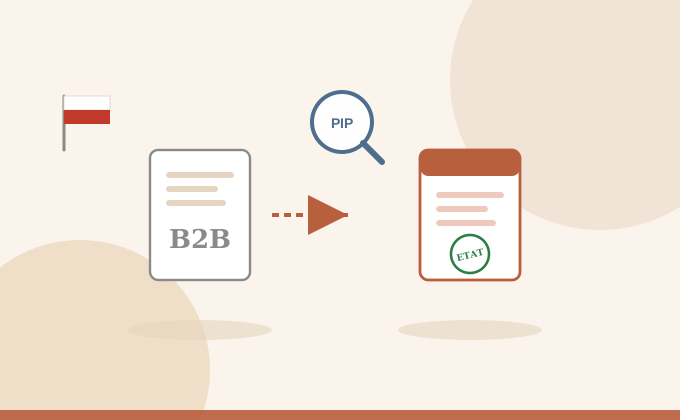
Does the labour inspectorate reform affect a JDG? Yes, indirectly. Since 8 July 2026 PIP can treat a B2B arrangement as employment where you in fact work as an employee of a single client. For a foreigner, the basis of the residence permit then comes into question too. Covered in the article on the labour inspectorate reform.


Comments