
I have a residence card — does that mean I can register a sole proprietorship?
Not necessarily. This is the central trap of the topic: the right to run a JDG comes not from holding a residence permit as such, but from a specific residence title on a closed statutory list.
The most awkward part: the work-based permit — the single permit for residence and work (article 114), the most common card type among foreigners in Poland — is not on that list. A person can live and work in Poland lawfully on a residence card and still be unable to register a sole proprietorship.
What you need to check isn't whether you hold a card, but the ground on which it was issued. That ground is stated in the voivode's decision.
Who can register on the same terms as Polish citizens?
Three groups, with no reference to the list of titles:
| Who | Basis |
|---|---|
| Citizens of the EU and the European Economic Area (including Norway, Iceland, Liechtenstein) | Same terms as Polish citizens |
| US citizens | Bilateral agreement |
| Swiss citizens | Bilateral agreement |
Ukrainian citizens — the rules have changed. The right to register a JDG on the same terms as Poles remains for beneficiaries of temporary protection, i.e. those with a PESEL carrying UKR status (including a non-Ukrainian spouse of a Ukrainian citizen who arrived because of the hostilities).
But since the law winding down the special measures (tzw. ustawa wygaszająca) came into force on 5 March 2026, this rule no longer applies automatically to all Ukrainian citizens. For those whose stay is unrelated to the war, the general grounds listed below apply rather than the preferential regime. Anyone already running a JDG under the previous rules may continue, provided their residence remains lawful.
Which residence titles carry the right?
For other third-country nationals — only one of those expressly listed in the act:
| Residence title | Provision |
|---|---|
| Permanent residence (zezwolenie na pobyt stały) | art. 4(2)(1)(a) |
| EU long-term resident status | (b) |
| EU Blue Card — permit for work in a profession requiring high qualifications | (c) → art. 127 of the Foreigners Act |
| Blue Card issued by another EU state, under long-term mobility to Poland | (c) → art. 137a |
| Temporary permit for studies | (c) → art. 144 |
| Temporary permit for conducting scientific research | (c) → art. 151(1) |
| Temporary permit for family reunification | (c) → art. 159(1) |
| EU long-term resident status granted by another EU state — intending to work, run a business or study in Poland | (c) → art. 186(1)(3) |
| A family member of such a person, accompanying or joining them | (c) → art. 186(1)(4) |
| Someone who has completed scientific research in Poland and is seeking work or planning a business | (c) → art. 186(1)(7) |
| Refugee status | (d) |
| Subsidiary protection | (e) |
| Consent to stay on humanitarian grounds, or tolerated stay | (f) |
| Temporary permit + marriage to a Polish citizen residing in Poland | (g) |
| Temporary permit to continue activity already registered in CEIDG | (h) |
| Temporary protection (ochrona czasowa) | art. 4(2)(2) |
| A valid Pole's Card | (3) |
| Family member of an EU citizen — spouse, child under 21 or dependent, dependent parent | (4) |
| Awaiting a decision on a filed application — only if the right already existed under (c) or (g) | (5) |
| Participant in a foreigner support programme on the list published by the Chancellery of the Prime Minister | (6) |
Note the second-to-last row: a pending application confers no right in itself. It extends a right you already held — if, immediately before filing, you were entitled to conduct business under (c) or (g). Someone applying for a permit for the first time will not open a JDG on this basis.
And note what is absent from the list: the work-based permit (article 114) and the intra-corporate transfer permit. That's the central trap — the most common employment ground confers no right to your own business activity.
Does the Blue Card confer the right to a JDG?
It does. This is worth stating plainly, because the claim "the Blue Card doesn't allow a JDG" is widespread — it was once correct, but it is out of date.
The Blue Card appears on the list twice over: art. 127 for the Polish Blue Card, and art. 137a for a Blue Card issued by another EU state under long-term mobility to Poland. Both references sit in art. 4(2)(1)(c). Neither was there in the original 2018 text of the act — the Blue Card was added later, by the reform in Dz.U. 2025 item 619, in force from 01.06.2025.
There is a limitation, but it concerns the basis of the permit, not the right to trade. Article 127 requires an employment contract of at least 6 months in a profession requiring high qualifications, with annual pay of no less than 150% of the national average. Business therefore works as a supplement to that employment rather than a replacement: abandoning the highly qualified role to move fully into a JDG puts the permit itself in question — not your right to trade, but the very thing the permit was granted for. More in the article on the Blue Card.
Who falls under the "family reunification" row?
This is the least self-evident row in the table, because the right turns not on you but on the basis under which your relative lives in Poland.
A permit under art. 159(1) is granted to a family member of a foreigner residing in Poland on one of these grounds:
| Your relative's basis in Poland |
|---|
| Permanent residence (pobyt stały) |
| EU long-term resident status |
| Refugee status |
| Subsidiary protection |
| At least 2 years on consecutive temporary permits — with the permit in force immediately before filing issued for a period of no less than 1 year |
A permit for conducting scientific research (art. 151(1)), or a national visa for that purpose |
A permit under art. 151b(1) |
| A permit for work in a profession requiring high qualifications (Blue Card) |
| An intra-corporate transfer permit |
The list continues with several narrower grounds — the full enumeration is in art. 159 ust. 1 pkt 1.
The practical takeaway: reunification is open to more than the families of permanent residents. It is enough that your relative has spent 2 years in Poland on ordinary temporary permits — there is no need to wait until they obtain permanent residence. And because the permit obtained this way is itself on the list of qualifying titles, it also opens the right to a JDG. A full walkthrough of the procedure is in a separate article on family reunification.
What if your title doesn't qualify?
Not having the right to a JDG doesn't close off business in Poland. There are three directions, differing in cost and complexity.
| Option | Minimum capital | Note |
|---|---|---|
| Sp. z o.o. (limited liability company) | 5,000 PLN | The most common form; it accounts for more new registrations than all other companies combined (article on Sp. z o.o.) |
| Spółka komandytowa (limited partnership) | none | Often paired with an Sp. z o.o. as general partner to cap the partners' personal liability |
| P.S.A. (simple joint-stock) | from 1 PLN | In force since 2021, popular with startups |
| S.A. (joint-stock) | 100,000 PLN | Predominantly larger businesses |
| S.K.A. | 50,000 PLN | The rarest and most complex; usually for specific tax structuring or business succession |
| Branch of a foreign company | — | If you already run a company abroad and this isn't excluded by a treaty with your country |
| Umbrella company / business incubator | — | No company at all: working under an intermediary's legal entity (article on the business incubator) |
The practical point: companies are available to foreigners regardless of residence basis — unlike a JDG. Important caveat, though: registering a company does not by itself confer a right to live in Poland; that's a separate question (article on Sp. z o.o.).
How does registration work?
Online via Biznes.gov.pl, or in person at any gmina office.
Online registration requires a PESEL number (to log into the Konto Przedsiębiorcy) and either a Trusted Profile or a qualified electronic signature to sign the application — the article on PESEL and Trusted Profile covers how to obtain both. Without a PESEL, you can register in person at the gmina by presenting your passport.
If you aren't an EU, EEA, US or Swiss citizen, you additionally attach a document confirming that your residence title carries the right to a JDG — usually a scan of the permit decision or of the card itself with its number.
Registration may formally take up to 30 days; in practice it usually completes within about a week.
Three things decided at registration that are expensive to change later:
- PKD codes. They determine whether you'll need a licence, concession or entry in a special register (transport, financial and medical services). An imprecise primary code creates friction with the tax office and ZUS afterwards.
- Business address (siedziba). If you rent, check with your landlord in advance that they don't object to a business being registered at the address. Some refuse, and that delays things.
- Taxation form (ryczałt, flat tax or the progressive scale). Chosen at the same time as the CEIDG filing, and generally cannot be changed mid-year — you'd wait for the next one.
What does it actually cost?
Registration is free and requires no starting capital. The real burden is ZUS, and it rises in steps.
| Period | What you pay |
|---|---|
| First 6 full calendar months | "Ulga na start": exemption from pension, disability and other social contributions. Health insurance remains mandatory and is calculated separately |
| Next 24 months | Preferential ZUS: social contributions based on 30% of the minimum wage — around PLN 456/month in 2026, plus health insurance |
| Thereafter | "Mały ZUS Plus" on modest income, or full-rate contributions |
Separately from ZUS:
- PIT — under the form chosen at registration;
- VAT isn't payable until turnover exceeds 240,000 PLN per year (2026 threshold; pro-rated if you start mid-year);
- simplified bookkeeping suffices up to EUR 2 million of turnover.
A detailed cost comparison across forms is in a separate article on costs.
A specific 2026 risk: reclassification as employment
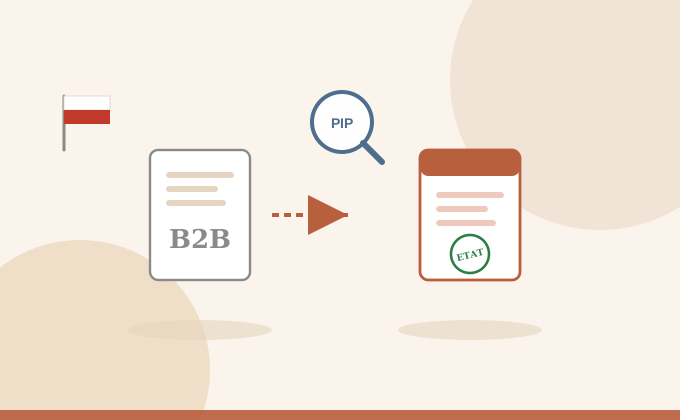
Worth knowing before you register. Since 8 July 2026, the labour inspectorate (PIP) can issue an administrative decision treating a B2B arrangement as an employment relationship — where the person in fact works as an employee: for a single client, on that client's schedule, using their equipment, following instructions.
For a foreigner this isn't only a tax question. If your residence permit was granted on the basis of your own business activity and PIP reclassifies the relationship as employment, the basis for that permit is thrown into question. There is no provision in law directly linking the two situations — this is risk analysis, not a rule — but your working model is worth reviewing in advance.
A 12-month voluntary correction window applies, running to roughly 8 July 2027. Full breakdown in the article on the labour inspectorate reform.
The list of qualifying titles is closed, and the most common permit — the work-based one — isn't on it. In a free consultation we'll look at your voivode's decision, tell you whether a JDG is open to you, and if not, identify a workable alternative.
Frequently asked questions
I hold a work-based permit. Can I register a JDG? No. The single permit for residence and work is not among the titles carrying the right to a JDG. Your options: change your residence basis to one on the list, register a company, or work through an umbrella company.
I hold a Blue Card. Can I register a JDG?
Yes. The Blue Card is on the list of qualifying titles: art. 4(2)(1)(c) refers to art. 127, and for a Blue Card issued by another EU state, to art. 137a. The widespread claim to the contrary is out of date — those references were added by the reform in force from 01.06.2025. What matters instead is that the business must supplement your highly qualified employment rather than replace it; otherwise the basis of the permit itself comes into question.
I'm a Ukrainian citizen — have the rules changed for me? If you hold a PESEL with UKR status, the right to register a JDG on the same terms as Poles remains. If your stay is unrelated to the war, since 5 March 2026 the general grounds on the list apply rather than the preferential regime.
Can I register a JDG without a PESEL? Not online — a PESEL is needed to access the Konto Przedsiębiorcy. But you can register in person at a gmina office by presenting your passport.
What does ZUS actually cost in the first year? The first 6 months: health insurance only (no social contributions). The next 24 months: around 456 PLN per month in social contributions plus health insurance. That's the cheapest stretch; the burden rises afterwards.
Can I change my taxation form if I got it wrong? Generally not mid-year — you'd wait for the start of the next one. Which is precisely why the choice at registration is worth calculating in advance rather than ticking at random.


Comments