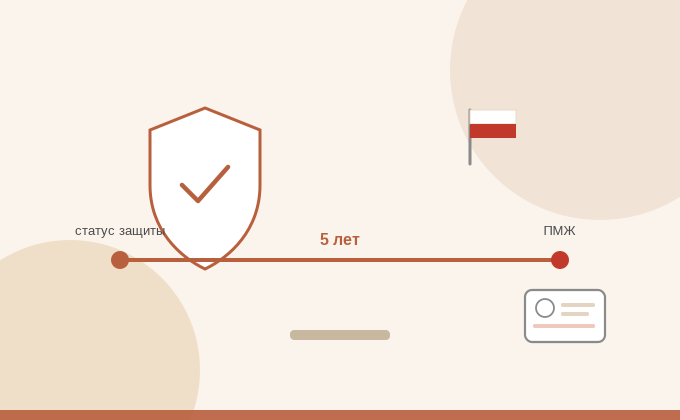
Three statuses — refugee, supplementary protection, and permission to stay on humanitarian grounds — travel to permanent residence by the same route and on the same conditions. The moment permanent residence is granted, they separate, and from there the difference is a year of your life plus income and housing requirements.
Everyone writes about the first part. Almost nobody about the second — even though it is what determines when you can apply for citizenship. Everything below was verified on 29 October 2026 against the consolidated texts: Act on Foreigners — Dz.U. 2025 item 1079; Citizenship Act — Dz.U. 2025 item 1611.
The route to permanent residence: one for all three statuses
Art. 195(1)(6)(a) grants permanent residence to a person who, immediately before filing, resided in Poland continuously for at least 5 years — verbatim: "w związku z nadaniem mu statusu uchodźcy, udzieleniem ochrony uzupełniającej lub na podstawie zgody na pobyt ze względów humanitarnych".
Three grounds in one provision, with one period. And more importantly — with no income or housing requirement. Compare (6)(c), where a single permit in a profession desirable for the Polish economy requires four years and a stable regular income. Here the provision contains no income test at all.
The permit is granted for an indefinite period (art. 195(1)), while the residence card issued on it is valid for 10 years (art. 243(1)(2)) — the document expires, not the permit.
What "continuously" means — and it is tested twice
The most common reason five years turn out not to be five. Art. 195(4): residence counts as continuous if no single break exceeded 6 months and all breaks together did not exceed 10 months — within the periods forming the basis for the permit.
Four exceptions, where a break does not count:
| Point | Exception |
|---|---|
(1) |
Performing professional duties, or working outside Poland under a contract with an employer whose seat is in Poland |
(2) |
A spouse or minor child accompanying such a person |
(3) |
A particular personal situation requiring presence outside Poland — and lasting no longer than 6 months |
(4) |
Travel abroad for internships or classes provided for in the programme of studies at a Polish university |
Note (1): what matters is not the country of work but where the employer's seat is. And (3): that exception has its own six-month ceiling, so a "particular personal situation" does not remove the limit, only shifts it.
And here is why it is tested twice. Art. 30(3) of the Citizenship Act points straight back to the same provision: to determine whether a foreigner resides continuously, art. 195(4) of the Act on Foreigners applies. So you pass the continuity test once for permanent residence, and then again for citizenship, under the same 6-and-10-month rule.
The turn: the three statuses separate at permanent residence
This is what made the article worth rewriting.
To permanent residence, a refugee, a holder of supplementary protection and a person with humanitarian permission travel together. But the Citizenship Act distinguishes between them, and the distinction is hard-edged.
Art. 30(1)(3) — verbatim: "cudzoziemca przebywającego nieprzerwanie na terytorium Rzeczypospolitej Polskiej co najmniej od 2 lat na podstawie zezwolenia na pobyt stały, które uzyskał w związku z posiadaniem statusu uchodźcy nadanego w Rzeczypospolitej Polskiej".
Refugee status only. Supplementary protection is not in that point. Humanitarian permission is not in it either.
What that means in practice:
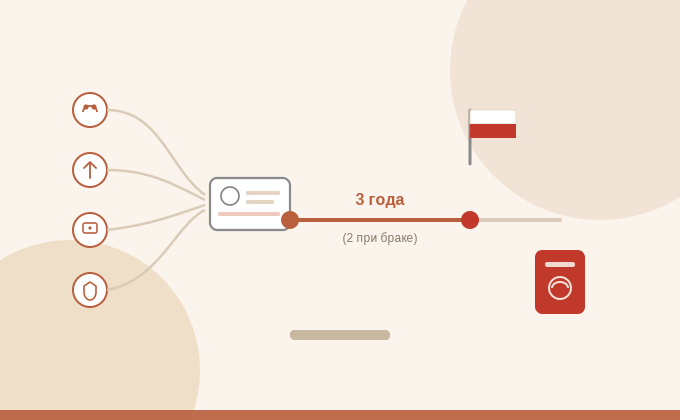
| Status the permanent residence was granted on | Route to citizenship | Period on permanent residence | Income and housing |
|---|---|---|---|
| Refugee status | art. 30(1)(3) |
2 years | Not required |
| Supplementary protection | General route, art. 30(1)(1) |
3 years | Both required |
| Humanitarian grounds | General route, art. 30(1)(1) |
3 years | Both required |
The difference is a year of your life plus two requirements a refugee does not face at all: "stabilne i regularne źródło dochodu oraz tytuł prawny do zajmowania lokalu mieszkalnego".
Why knowing this early matters. Someone granted supplementary protection often plans like a refugee — because they reached permanent residence under the same provision on the same conditions. That plan does not hold: after permanent residence there is another year to serve, and income and legal title to a dwelling to document.
The other routes to citizenship, for completeness
Art. 30(1) lists seven grounds. Besides those above:
| Point | Condition |
|---|---|
(2)(a) |
2 years on permanent residence, EU resident status or a right of permanent residence + at least 3 years married to a Polish citizen |
(2)(b) |
2 years on the same grounds — for a stateless person |
(4), (5) |
Minors: one parent is a Polish citizen and the other consented; or one parent had Polish citizenship restored |
(6) |
10 years continuously and lawfully, holding permanent residence, EU resident status or a right of permanent residence, plus income and housing |
(7) |
1 year on permanent residence obtained in connection with Polish origin or a Karta Polaka |
Note (6): this is the route for those with no shorter ground. Ten years, but the whole period must be lawful, not merely continuous.
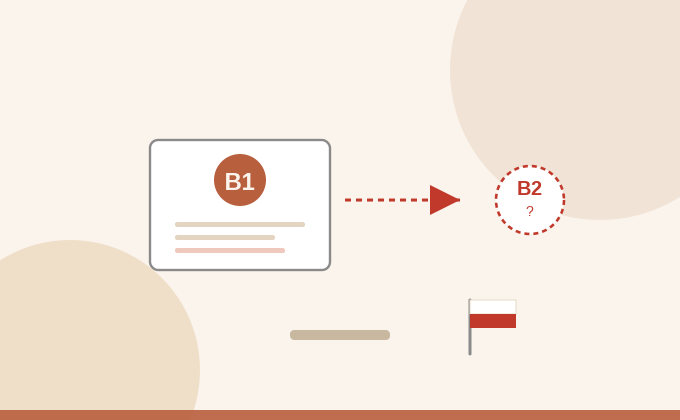
Language: B1, and not every document counts
Art. 30(2): a foreigner seeking recognition as a Polish citizen — except minors under (4) and (5) — must have knowledge of Polish confirmed by:
- an official certificate under
art. 11a of the act of 7.10.1999 on the Polish languageat a level of no less than B1, or - a certificate of completing a school in Poland, or
- a certificate of completing a school abroad where Polish was the language of instruction.
(2a) adds a separate caveat: a certificate of completing a szkoła policealna (under art. 18(1)(2)(f) of the Education Law) does not confirm knowledge of the language.
The level is B1 — not B2 and not C1. Figures from citizenship-reform bills have no bearing on the provision in force.
What to expect procedurally
A decision on a permanent residence permit is issued within 6 months (art. 210(1)), and appeal proceedings end within 90 days (art. 210(3)). But those periods are suspended by art. 100d of the act of 12.03.2022 on assistance to Ukrainian citizens until 4 March 2027 — and for all foreigners regardless of nationality (covered in our article on the deadline freeze).
Proof of filing is the certificate under art. 206(1)(1), the mirror of art. 108 for temporary residence: with a QR code, free of charge, delivered through MOS.
And one ground for not opening a case that has no equivalent in the temporary-residence provision: art. 196(1)(1)(a) — unlawful stay on the filing date. For temporary residence, unlawfulness works differently: the case is opened but refused under art. 100(1)(9) (covered in our article on refusal grounds). Here the case is simply never started.
Two questions decide it: does your period survive the continuity test under art. 195(4), and which status exactly is named in your decision. In a free consultation we'll count it out by dates.
Frequently asked questions
Is it true that supplementary protection gives the same five years to permanent residence as refugee status?
Yes. Art. 195(1)(6)(a) names refugee status, supplementary protection and humanitarian permission in one provision, with one period and no income or housing requirement.
So the period to citizenship is the same too?
No, and this is the key difference. Art. 30(1)(3) gives the two-year route only to those who obtained permanent residence in connection with refugee status. Supplementary protection and humanitarian permission go the general (1) route: three years plus a stable regular income and legal title to a dwelling.
I was away for seven months for personal reasons. Has the clock reset?
Most likely yes. Art. 195(4) permits a break longer than 6 months only under (1), (2) and (4). The (3) exception for a particular personal situation is itself capped at six months.
I worked abroad under a contract with a Polish company — is that a break?
No, provided the employer's seat is in Poland (art. 195(4)(1)). A spouse and minor child accompanying such a person are also covered ((2)).
Is continuity assessed again for citizenship?
Yes. Art. 30(3) of the Citizenship Act applies the same art. 195(4). You pass the 6-and-10-month rule twice — for permanent residence and then for citizenship.
What level of Polish is needed?
B1 (art. 30(2)). Confirmed by an official certificate, a Polish school certificate, or a certificate from a school abroad taught in Polish. A szkoła policealna certificate does not qualify ((2a)).
Are income and housing needed for the permanent residence itself?
No. Art. 195(1)(6)(a) contains no such requirements. They appear later — at the citizenship stage, and only for supplementary protection and humanitarian permission.
What is in this article and what is not
| Topic | Where |
|---|---|
| Every route to citizenship and the periods in force | Polish Citizenship: Every Route |
| Citizenship via permanent residence in detail | Citizenship via Permanent Residence |
| How permanent residence differs from EU resident status | Residence Permits in Poland |
| Procedure, fees, documents | Karta Pobytu: Timelines, Cost, Documents |
| Grounds for refusal and the four different "no"s | Residence Permit Refusal in Poland |
| Why there are currently no statutory deadlines | Poland's Residence Deadline Freeze |

Comments