Do the years spent on a temporary residence card count?
No. And this is the most expensive misconception in the whole topic.
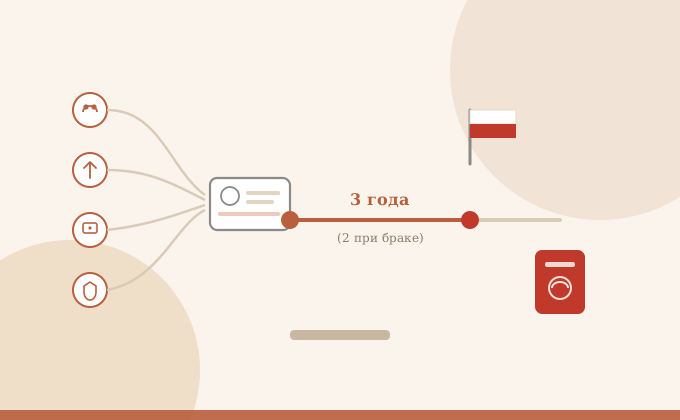
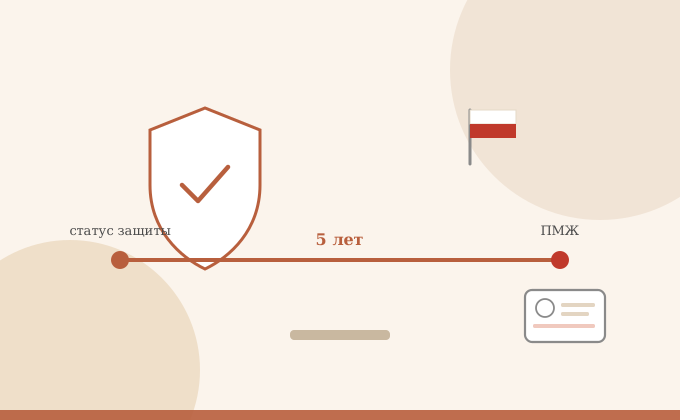
The clock toward citizenship starts from the date of the permanent residence decision (zezwolenie na pobyt stały) — not from your first arrival in Poland, and not from your first temporary permit. Someone can live in the country for eight years on temporary cards, obtain permanent residence, and discover they still have three years to go.
The one exception is a separate ten-year route (article 30(1)(6)): ten years of continuous legal residence, where you don't have to spend all of it on permanent residence, but you must hold permanent residence or EU long-term resident status when you file, plus proven income and housing. For most people that's longer than the standard route, so it's rarely used.
The practical takeaway: don't count "how long I've lived in Poland" — count from the date of your permanent residence decision.
What determines the term — 1, 2 or 3 years?
The ground on which the permanent residence itself was granted. The difference between options is threefold, and this is the second thing people usually don't know.
| Ground for permanent residence | Time on permanent residence before citizenship | Income and housing required? |
|---|---|---|
| Polish origin or a valid Pole's Card (point 7) | 1 year | No |
| Marriage to a Polish citizen, 3+ years of marriage (point 2a) | 2 years | No |
| Statelessness (point 2b) | 2 years | No |
| Refugee status (status uchodźcy) granted in Poland (point 3) | 2 years | No |
| Subsidiary protection (ochrona uzupełniająca) — no shortened term | 3 years | Yes |
| Any other ground — the general case (point 1) | 3 years | Yes |
| 10 years of continuous legal residence (point 6) | 10 years, not necessarily all on permanent residence | Yes |
Note the right-hand column: the shortened routes free you not only from years of waiting but also from proving stable income and the right to housing. For the general three-year route and the ten-year route, those documents are mandatory.
A word on protection statuses — this is easy to get wrong. "International protection" (ochrona międzynarodowa) is an umbrella term covering two distinct forms: refugee status (status uchodźcy) and subsidiary protection (ochrona uzupełniająca). For citizenship purposes, they are treated separately.
The two-year term in point 3 is tied strictly to refugee status. Subsidiary protection is not covered by this point. It is a separate status, and permanent residence is granted on its own ground (see article on permanent residence via supplementary protection) — but for citizenship purposes such a person falls under the general three-year route in point 1, with all its income and housing requirements. The difference from refugee status: one extra year of waiting plus two additional documents.
One more nuance worth checking against your own decision: the shortened routes in points 3 and 7 — refugee status and origin/Pole's Card — are tied by law only to permanent residence (zezwolenie na pobyt stały). The routes under points 1 and 2 also count EU long-term resident status and the right of permanent residence.
In every case except minors, you need a certificate of Polish at B1 or above (article 30(2)), regardless of the ground. What the exam actually involves is covered in the article on the B1/B2 exam.
Two people with identical permanent residence cards can face different timelines
A pobyt stały card looks the same for everyone. But if one person got theirs via a Pole's Card, they're one year from citizenship with no income paperwork. If another got theirs on the general ground, it's three years plus proof of income and housing. The statuses look identical; the legal routes differ by a factor of three.
Hence a practical tip: if you don't remember exactly which ground is stated in your voivode's decision — check the decision, not the card. It's the wording in the decision that determines how long you wait.
And the reverse case: if you haven't yet applied for permanent residence and have a choice of ground, that choice affects not only how hard the permit is to obtain but also how long you'll wait for citizenship. Sometimes it's worth the effort to document Polish ancestry (article on permanent residence via Polish origin) or obtain a Pole's Card (article on getting the Pole's Card) even when an easier ground is available — two extra years of waiting is a meaningful price.
What documents does the citizenship application require?
The core set, common to all scenarios: proof of identity and a valid pobyt stały card; proof of unbroken residence on permanent residence for the required period; a certificate of Polish at B1 or above.
Additionally — only for the general three-year and the ten-year routes: proof of a stable and regular source of income; documented right to occupy housing in Poland.
For the marriage route you'll also need the marriage certificate (in sworn translation if issued abroad) and, where required, evidence of cohabitation; how the permanent residence through marriage route itself works is covered in a separate article.
What does it cost and how long does it take?
| Item | Amount |
|---|---|
| Voivode's decision on recognition as a citizen | 1,000 PLN |
| Presidential act granting citizenship (a separate procedure) | 1,669 PLN |
Processing time depends on the voivodeship — realistically, plan for several months. That runs on top of the years already spent obtaining permanent residence itself.
Will the 10-year reform affect you?
As of publication, none of the proposals has been enacted — the current terms and the B1 requirement still apply.
| Proposal | What it would change | Status as of 27.08.2026 |
|---|---|---|
| Parliamentary (PiS) | 3 → 10 years | Rejected by the Sejm on 9 January 2026 |
| Presidential | 3 → 10 years | In the Sejm, awaiting consideration |
| Government (Ministry of Interior) | 8 years (3 temporary + 5 permanent), exam on history and constitutional values, loyalty declaration, tax residency | Announced, not yet before the Sejm |
What matters specifically for readers of this article: the presidential bill names pobyt stały among the affected grounds and proposes extending the term from 3 to 10 years. That concerns primarily the general three-year term. Whether the amendment would touch the shortened routes — one year for Polish origin and the Pole's Card, two years for marriage, refugee status or statelessness — does not follow unambiguously from open sources. This is worth tracking as the bill progresses rather than treating as settled either way.
A detailed breakdown of all three proposals is in the article on all routes to Polish citizenship.
Already hold permanent residence and counting the years to citizenship? In a free consultation we'll calculate your term precisely, based on the ground stated in your voivode's decision, and map out what you still need.
Frequently asked questions
Does the ground my permanent residence was granted on affect how long I wait for citizenship? Yes, significantly: 1 year for Polish origin or a Pole's Card, 2 years for marriage of at least 3 years, refugee status or statelessness, 3 years in the general case. The shortened routes additionally remove the income and housing requirements.
I've lived in Poland for 7 years, 2 of them on permanent residence. Do I count 7 or 2? For the standard route — 2. The clock runs from the permanent residence decision. Years on temporary permits count only under the separate ten-year variant (article 30(1)(6)), which also requires income and housing.
If my permanent residence was revoked and then reinstated, does the time still count as continuous? Revocation and reinstatement generally mean the clock starts over. These cases are worth reviewing individually — there's no single answer that fits every situation.
Is it true that the 3-to-10-year bill has already been passed? No. The parliamentary bill was rejected on 9 January 2026, the presidential one remains before the Sejm, and the government's version has been announced but not submitted. None has become law.
I have Polish ancestry — is this article about my situation? Probably not, and the two routes are easy to confuse. This article covers recognition as a Polish citizen (uznanie za obywatela polskiego, chapter 4, articles 30–37), which requires actually living in Poland on permanent residence.
If your ancestor was a Polish citizen and never lost that status, a fundamentally different procedure applies: confirmation of Polish citizenship (potwierdzenie posiadania obywatelstwa polskiego, chapter 7, articles 55–58). This is what's usually called "Polish citizenship by descent" in English — but legally it isn't acquiring citizenship at all. It's establishing that you already hold it, inherited by descent. That's why none of this article's requirements apply: no residence in Poland, no permit, no waiting period, no language exam. Jurisdiction: the voivode where you live in Poland — or, if you have never lived in Poland, the Mazowieckie voivode (article 55(1)).
The real difficulty lies elsewhere: you must document an unbroken chain of citizenship from your ancestor down to you. "My grandmother was Polish" settles nothing on its own — if your ancestor lost Polish citizenship before the next person in the chain was born, there was nothing left to pass on. Related routes: permanent residence based on Polish origin and repatriation.

Comments