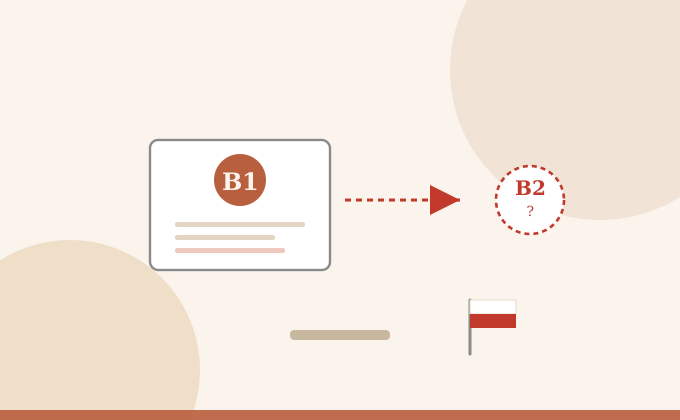
Do you need a B1 certificate right now, or can it wait?
It depends on which status you're applying for. This is where people most often waste money and time: they sit the exam long before it's needed, or discover the requirement at the last moment.
| What you're applying for | Is B1 required at this step? |
|---|---|
| Permanent residence (pobyt stały) on most grounds — origin, Pole's Card, marriage, protection | No |
| EU long-term resident status (rezydent długoterminowy UE) | Yes — it's a condition of the status itself |
| Citizenship via permanent residence or via EU resident status | Yes |
| Citizenship for minors under article 30(1)(4) and (5) | No — they are expressly excluded |
The practical takeaway: permanent residence and the certificate are separate stages. If your route is "permanent residence → citizenship", the language requirement arrives not at the start but at the next step, and that can be years away (how many — article on citizenship via permanent residence). If you're aiming for EU long-term resident status, however, the certificate is needed at the point of applying for the status itself (article on obtaining EU resident status).
Is it true that B2 is now required?
No. As of publication, B1 applies, and there is no additional civics exam for citizenship.
The confusion comes from the government's proposal. What has actually been announced:
| Announced by the Ministry of Interior | Status |
|---|---|
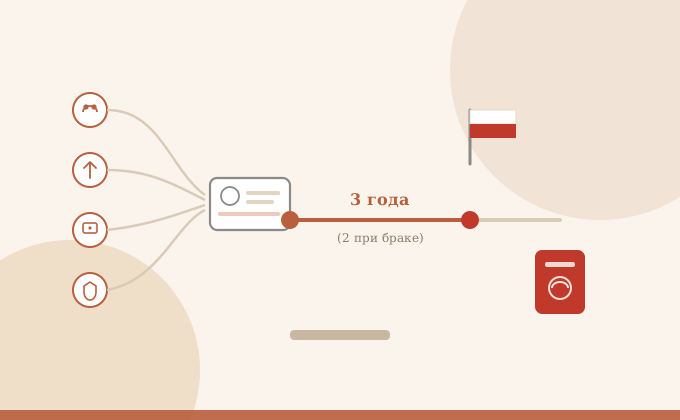
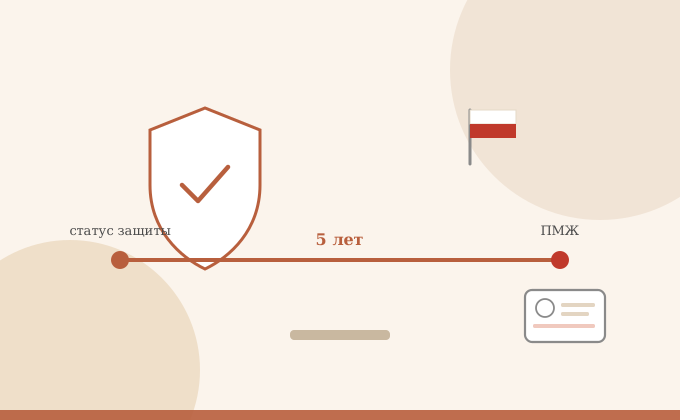
| 8 years of residence: 3 temporary + 5 permanent | Announced, not yet before the Sejm |
| An exam on history and constitutional values | Announced, not yet before the Sejm |
| A loyalty declaration | Announced |
| A tax residency requirement | Announced |
A word on the figures circulating in coverage: the "40-question exam" and the "B2 level" are not separately confirmed in the current public concept. They originate from earlier reporting on the proposal's development. The concept does include an exam, but it is described as a test on history and constitutional values, not as a raised language level.
A breakdown of all three citizenship bills and how they differ is in article on all routes to citizenship.
What is this exam and where do you take it?
What's required is a state certificate, issued following an exam organised in accordance with the requirements of the State Commission for the Certification of Proficiency in Polish as a Foreign Language (Państwowa Komisja Poświadczania Znajomości Języka Polskiego jako Obcego). Only that certificate is reliably accepted by voivodeship offices.
The exam is administered by authorised centres across Poland — the current list is published by the responsible ministry. B1 sessions for adults are held several times a year; check the schedule and availability for your city well in advance — places are often taken long before the date.
Adults may sit the exam, as may those aged 16 and over with written consent from a parent or guardian.
Who can skip the exam entirely?
The law allows language knowledge to be evidenced by more than a certificate. Under article 30(2), the following also qualify:
- a school leaving certificate from Poland where instruction was in Polish;
- a university diploma from Poland where instruction was in Polish;
- a school leaving certificate from abroad where instruction was in Polish.
An important exception (article 30(2a)): a post-secondary school certificate (szkoła policealna within the meaning of article 18(1)(2)(f) of the Education Law) does not evidence language knowledge. It's a narrow but real trap — you hold an education document, and it doesn't meet the requirement.
If you studied in Polish, check your document before paying for an exam: you may not need to pay at all.
Why it's worth taking the exam early, even if your deadline is far off
There's a detail here that changes strategy: the state certificate has no expiry date. Unlike many international language certificates, it is accepted regardless of how long ago it was issued.
Two practical consequences follow.
First: you can take it well before filing. If your route is "permanent residence → citizenship" and you're still two or three years from the required period, a certificate obtained now will still be valid then. The exam isn't something to leave until the last moment, especially since session places are limited.
Second: it's a hedge against the reform. The language requirement is being discussed in the context of tightening. A certificate already in hand will — by the usual logic of transitional provisions — most likely retain its force for procedures started under the current rules. There's no guarantee, because transitional provisions will only be known from the final text of the act, but sitting the exam earlier is a stronger position than sitting it afterwards.
The flip side: if you're exempt on the basis of an education document (see above), there's no point paying for an exam — check the document first.
Sitting an exam you don't yet need wastes money and time. Failing to sit one you do need derails your filing. In a free consultation we'll map your route and tell you at which step the language requirement arrives — and whether it arrives at all.
Frequently asked questions
Do I need B1 to obtain permanent residence itself? On most grounds, no. The certificate becomes mandatory at the next step, when applying for citizenship. The exception is EU long-term resident status, where the language is required to obtain the status itself.
Is a B1 certificate obtained several years ago still valid? Yes. The state certificate of Polish language proficiency has no expiry date and is accepted regardless of when it was issued.
Is it true that a B2 exam is already mandatory? No. B1 applies. The B2 level appeared in earlier reporting on the proposal, but it isn't separately confirmed in the Ministry of Interior's current announced concept, which refers to an exam on history and constitutional values.
I have a Polish university diploma — do I still need the exam? If the instruction was in Polish, the diploma evidences language knowledge. But a post-secondary school certificate (szkoła policealna) is expressly excluded by the law. Check your specific document in advance.
What happens to my B1 certificate if the requirements are raised? There's no definitive answer on an unenacted law — the transitional provisions will come from the final text. As a rule, new requirements apply to procedures started after entry into force, so a certificate obtained in advance is the stronger position.

Comments