
Is it true that citizenship now takes 10 years?
No. None of the proposals under discussion has become law. As of publication, the existing terms apply — 3, 2 or 1 year depending on the basis — along with the requirement of Polish at B1 level.
The confusion arises because there are three separate proposals of different origin, and retellings routinely merge them into one. Here's how it actually stands:
| Proposal | What it would change | Status as of 27.08.2026 |
|---|---|---|
| Parliamentary (PiS) | Extend the term from 3 to 10 years | Rejected by the Sejm at first reading on 9 January 2026 |
| Presidential | Extend the term from 3 to 10 years | Submitted to the Sejm, awaiting consideration |
| Government (Ministry of Interior) | 8 years of residence (3 temporary + 5 permanent), an exam on history and constitutional values, a loyalty declaration, tax residency | Announced, not yet before the Sejm |
Note an important detail: the one rejected in January and the presidential one still alive are different proposals with similar content. The headline "the Sejm rejected the 10-year bill" is accurate but does not mean the matter is closed.
All three point the same way — tightening. But that is a direction, not current law.
Which routes to citizenship apply today?
Four, and they work in fundamentally different ways.
Recognition as a Polish citizen (uznanie za obywatela polskiego) — the main route. The decision is made by the voivode of your place of residence, not the President. It requires accumulated legal residence on a specific type of permit:
| Term | Condition |
|---|---|
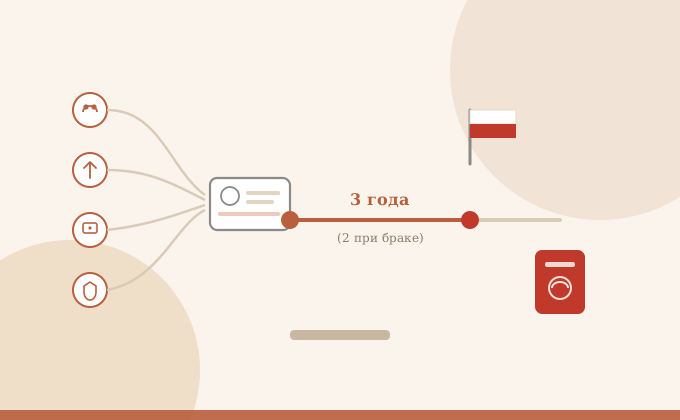
| 3 years | continuous residence on permanent residence (pobyt stały), EU long-term resident status, or the right of permanent residence — the standard case |
| 2 years | the same statuses plus at least 3 years of marriage to a Polish citizen, or statelessness |
| 2 years | permanent residence granted in connection with refugee status (status uchodźcy) held in Poland |
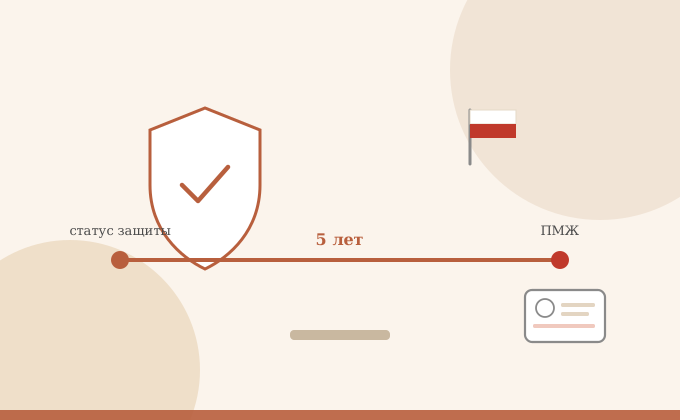
| 3 years | permanent residence granted via subsidiary protection (ochrona uzupełniająca) — no separate shortened term exists for it; the standard case applies, with income and housing |
| 1 year | permanent residence granted on the basis of Polish origin or a Pole's Card |
A key nuance in that last row: the year runs not from the date you received the Pole's Card, but from the date you received permanent residence on its basis. These are different dates and they get confused constantly — see the articles on permanent residence by origin and by the Pole's Card.
Two traps in this table that people stumble over most often:
- International protection is two different statuses, and the law treats them differently. The term "international protection" (ochrona międzynarodowa) covers two forms: refugee status (status uchodźcy) and subsidiary protection (ochrona uzupełniająca). The shortened two-year term under article 30(1)(3) applies only to the first. A holder of subsidiary protection gets permanent residence on its own ground (see the article on permanent residence via subsidiary protection), but for citizenship purposes falls under the general three-year route, plus proof of income and housing. The difference: one extra year of waiting plus two extra documents. More detail: the article on citizenship via permanent residence.
- The shortened routes are tied only to permanent residence. The one-year route for origin/Pole's Card and the two-year route for refugee status count exclusively pobyt stały. EU long-term resident status doesn't qualify there, even though it counts equally with permanent residence in the three-year and two-year "marriage" variants.
Grant of citizenship by the President (nadanie obywatelstwa polskiego) — a discretionary act. The President may grant citizenship to any foreigner with no residence requirement at all, at their own discretion and without any duty to justify a refusal. This is an exceptional mechanism, not a shortcut.
Repatriation — a standalone route for people of Polish descent whose ancestors ended up in the territory of the former USSR. Citizenship arises automatically at the moment of crossing the border on a repatriation visa — there's no separate decision to wait for after arrival. Covered in detail in the article on repatriation.
Confirmation of citizenship (potwierdzenie posiadania obywatelstwa polskiego) — legally not an acquisition of citizenship but the establishment that a person already holds it by descent. No residence in Poland, no permit and no language requirement. See the article on citizenship via permanent residence.
Which route is actually the fastest?
Here's what gets lost in the ten-year discussion: for some people the timeline is measured not in years of waiting but in a single year — or a single day.
- Repatriation grants citizenship on the day you cross the border. Not in a year, not in three — immediately.
- One year instead of three — if permanent residence was granted on the basis of Polish origin or a Pole's Card. That's a threefold difference.
- Confirmation of citizenship requires no residence in Poland at all: if the chain from your ancestor is unbroken, you are already a citizen and simply don't know it.
The right starting point isn't counting years — it's asking whether you have a basis that eliminates those years altogether. Checking for Polish ancestry is worth doing even on thin family leads; documents sometimes turn up where nobody expected them.
The flip side: if you're still far from the required period, rushing an incomplete application produces a refusal, and a refusal damages your case history (see the article on grounds for refusal). Speed only helps where the basis genuinely exists.
What do you need to prove on paper?
The document set depends on the basis, but recognition through accumulated residence generally requires:
- proof of identity and of lawful residence on the chosen basis;
- proof of unbroken legal residence for the required period;
- proof of a stable and regular source of income;
- documented right to occupy housing in Poland;
- a certificate of Polish at B1 or above (what the exam actually involves — the B1/B2 exam article);
- civil status documents in sworn translation, where required.
What does it cost and how long does it take?
| Item | Amount |
|---|---|
| Voivode's decision on recognition as a citizen | 1,000 PLN (since 01.08.2025) |
| Presidential act granting citizenship | 1,669 PLN |
Processing time depends on the basis and the workload of the particular voivodeship office — realistically, plan for several months.
What should you do right now if the reform worries you?
The practical answer depends on where you stand relative to the required period.
If you already have the required residence, or will within months — don't postpone. The transitional provisions of any future act are unknown, but new requirements typically apply to applications filed after entry into force. A filed case is a stronger position than an intention to file.
If the required period is still far off — there's no need to rush, but two things are worth checking: whether a shorter basis applies to you (see above), and whether your legal residence is genuinely unbroken. Gaps in the record surface at the worst possible moment.
In any case — re-check the status of the proposals before filing. The legislative process is live and can move faster than expected.
Residence, marriage, ancestry, a Pole's Card or repatriation — each route has its own timeline, and the difference between them can be several years. In a free consultation, we'll review your situation and calculate how far you are from filing.
Frequently asked questions
What if I file now and the law changes while my case is pending? There's no definitive answer on an unenacted law. As a rule, new requirements apply to applications filed after entry into force, but the exact transitional provisions will only be known from the final text. That's an argument for not postponing if you already meet the current conditions.
Should I start preparing for the history and constitutional values exam? Not yet. That's part of the Ministry of Interior's announced concept, which hasn't reached the Sejm. The current requirement is B1 — a standard language certificate.
The Sejm rejected the 10-year bill — so it's all cancelled? What was rejected was the parliamentary bill, on 9 January 2026. The presidential bill proposing the same term remains in the Sejm awaiting consideration, and the Ministry of Interior is preparing its own version. The matter is not closed.
How does "recognition" differ from a "grant by the President"? Recognition follows formal criteria (residence, marriage, origin), is decided by the voivode, and cannot be refused at discretion once the conditions are met. A presidential grant is discretionary, has no residence requirement, and is applied selectively.
My grandfather was Polish. Do I still need to accumulate residence? Possibly not. There are three different scenarios here with very different timelines: confirmation of citizenship you already hold (no residence needed at all), permanent residence by origin followed by one year to citizenship, and repatriation. Which one applies depends on what your documents can establish.

Comments