Do you need to pass a B1 exam?
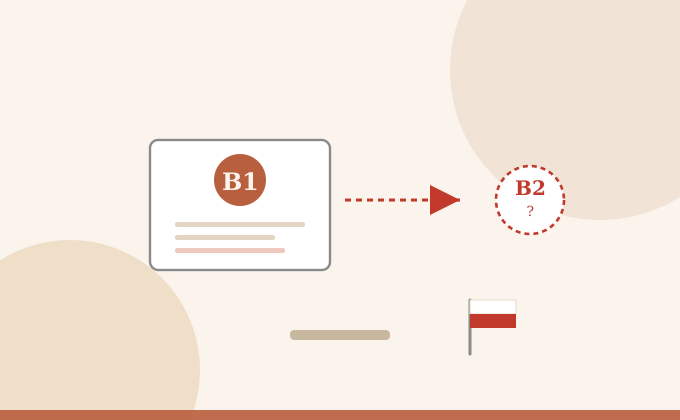
No. There is no formal language exam on the international scale for the Pole's Card — neither B1 nor B2. This is one of the most persistent misconceptions around the topic, and it stops people who in fact meet the requirements.
The law (article 2(7)–(8)) distinguishes two situations:
| Your situation | How language is evidenced |
|---|---|
| You hold a document — a certificate of Polish as a foreign language, a school certificate or university diploma from Poland, or a foreign school certificate with Polish as the language of instruction | The document suffices; no separate language assessment is carried out |
| You have no such document | Language is assessed by the consul during the interview (or by a voivodeship official if filing in Poland) — a conversation in Polish about traditions, history and customs |
Fluency is not required. What's assessed is a basic conversational level — the ability to hold a conversation, not academic proficiency.
On what grounds can you apply?
Two independent routes, and the second is far less widely known than the first.
| Ground | What's required |
|---|---|
| Polish origin | At least one parent, grandparent, or two great-grandparents of Polish nationality. Evidenced by documents: birth and marriage certificates, parish records, statements establishing the family link |
| Activity supporting Polish culture | At least 3 recent years of active engagement in activity supporting the Polish language and culture or the Polish national minority, certified by a Polish or Polonia organisation |
The second route exists for those whose archives didn't survive. This is common among descendants of the repressed and deported: the ancestry is real, the documents are gone. The law accounts for it — no genealogy is required in that case.
The provision (article 2(1)(3)) reads: "zaświadczenie organizacji polskiej lub polonijnej, potwierdzające aktywne zaangażowanie w działalność na rzecz języka i kultury polskiej lub polskiej mniejszości narodowej przez okres co najmniej ostatnich trzech lat".
On either ground you must additionally submit a written declaration of belonging to the Polish nation and demonstrate basic knowledge of the language.
Do you have to travel to a consulate?
No — and this is the second thing people often don't know.
| Where to file | When it applies |
|---|---|
| A Polish consulate in your country of residence | The classic route, if you live outside Poland |
| A voivodeship office (urząd wojewódzki) in Poland | If you already reside lawfully in Poland — no trip abroad needed |
The procedure is in person either way: you attend personally, present your original passport, give fingerprints and a signature sample. The decision follows within 2 months of filing.
What does it cost?
Nothing. Filing, renewal and all related consular actions are free by law, including the consular fee.
This is a rare case among immigration procedures, and intermediaries occasionally exploit it by charging for "assistance with filing". The procedure itself carries no state fee.
What does the card give you on its own — without relocating?
| What it gives |
|---|
| The right to work in Poland without a separate work permit |
| The right to run a business on the same terms as Polish citizens |
| Access to education |
| Emergency medical care |
| Entitlement to a multiple-entry national visa |
| A 37% discount on Polish railway (PKP) tickets |
| Priority in the processing of repatriation applications, should that route be chosen later (the article on repatriation) |
The card solves what a work-based permit doesn't
Here's a non-obvious consequence of the second row that deserves attention.
The right to conduct business activity in Poland is conferred not by any residence permit but only by a title on a closed statutory list. The work-based permit — the most common card type — is not on that list (see the article on sole proprietorship). A person works in Poland lawfully on a residence card and cannot register a sole proprietorship.
A valid Pole's Card is on that list. So the card resolves a question the work-based permit does not — and it does so regardless of whether you've moved to Poland.
The second consequence concerns timelines. Permanent residence obtained on the basis of a Pole's Card shortens the path to citizenship to one year instead of the general three, and without proof of income or housing (mechanics — the article on citizenship via permanent residence). That's a threefold difference against the standard route.
The practical conclusion: if you have grounds for the card, obtaining it makes sense even if you already hold another valid permit — it addresses both the business question and the timeline.
How long is the card valid and how do you renew it?
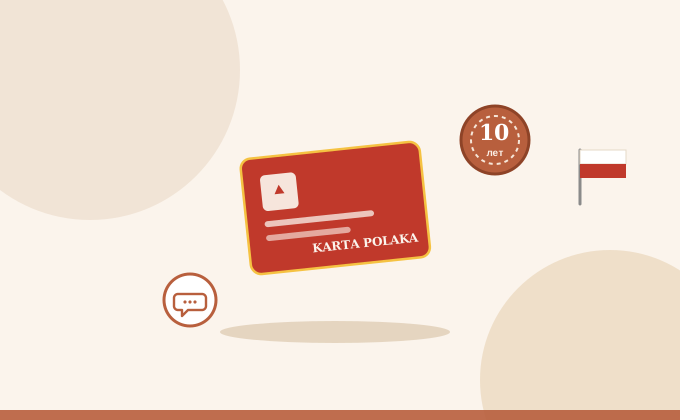
The card is valid for 10 years. It can be renewed for a further 10 years — the renewal application must be filed no later than 3 months before the current period expires.
What comes next if the goal is relocation?
The card alone doesn't legalise residence. The next step is permanent residence:
- on the basis of the card already obtained — the standard track, the article on permanent residence via the Pole's Card;
- by Polish origin without a card — if you have the documents but chose not to apply for the card, the article on permanent residence by origin.
There are two grounds, and the second — requiring no ancestry documents — is far less known than the first. In a free consultation we'll work out what can be evidenced in your case and advise where to file: at a consulate or already in Poland.
Frequently asked questions
Can I obtain the card if no ancestry documents survived? Yes, via the second ground — at least 3 years of active engagement supporting Polish language and culture, certified by a Polish or Polonia organisation. It's a standalone route requiring no documentary genealogy.
Do I need to speak Polish fluently? No. A basic level is required, assessed in conversation — and only if you don't hold a certificate or school document. The card requires no formal B1/B2 exam.
Is the Pole's Card already a residence permit? No. The card confirms belonging to the Polish nation and confers a range of rights, but it doesn't automatically legalise residence in Poland. That requires a separate permanent residence permit — the article on permanent residence via the Pole's Card.
What does filing cost? Nothing. Filing, renewal and all related consular actions are free by law, including the consular fee.
Can I apply if I already live in Poland? Yes, at a voivodeship office — no trip to a consulate abroad is needed. Attendance is in person, with your original passport, fingerprints and a signature sample.
I already hold a work-based permit — does the card add anything? Yes, at least two things: the right to run your own business (which the work-based permit doesn't confer) and, on subsequently obtaining permanent residence on the basis of the card, a reduction of the path to citizenship from three years to one.
Comments