I have Polish ancestry — does that mean I can repatriate?
Most likely not. And the reason isn't the ancestry — it's geography.
Alongside Polish origin, the law requires a second condition: that the applicant permanently resided before 1 January 2001 in one of a strictly listed set of territories.
| Territories that give rise to repatriation rights |
|---|
| Republic of Armenia |
| Republic of Azerbaijan |
| Georgia |
| Republic of Kazakhstan |
| Kyrgyz Republic |
| Republic of Tajikistan |
| Turkmenistan |
| Republic of Uzbekistan |
| The Asian part of the Russian Federation |
Ukraine and Belarus are not on this list. Nor is the European part of Russia. That rules out a substantial share of people with Polish ancestry who have heard about repatriation and are counting on it.
The logic behind the law is historical: repatriation was designed as a return route for the descendants of Poles deported to or stranded in Asia and the South Caucasus — not as a general channel for anyone with a Polish ancestor.
As for the ancestry requirement: the applicant declares Polish nationality, and at least one parent or grandparent, or two great-grandparents, were of Polish nationality.
Additionally, the right applies only to those who do not hold Polish citizenship and intend to settle in Poland permanently.
Who can come with you?
Here the law is unexpectedly generous, and this is not widely known.
A repatriation visa may also be issued to:
- the spouse of a person entitled to repatriation;
- their descendants up to the fourth degree of kinship — together with those descendants' spouses.
And crucially, family members do not need Polish ancestry of their own. The only condition is that they arrive in Poland together with the repatriate, intending to settle permanently.
So one person who meets the criteria opens the route for a fairly wide circle of relatives.
How does repatriation differ from every other route?
Fundamentally — in how citizenship is acquired.
| Repatriation | All other routes (ancestry, Pole's Card, marriage, EU resident status) | |
|---|---|---|
| Intermediate permanent residence stage | Not required | Mandatory |
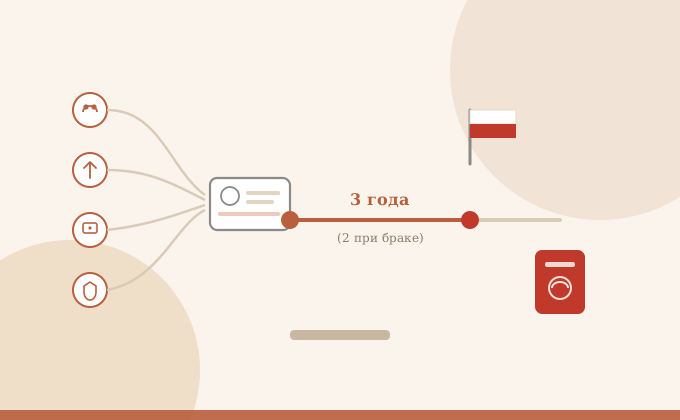
| Years of residence counted | None | 1 to 3 years on permanent residence |
| Who decides | The consul issues the visa; citizenship arises by operation of law | The voivode recognises you as a citizen |
| When citizenship is acquired | The day you cross the border on a repatriation visa | The voivode's decision after the qualifying period |
| Where the procedure starts | A consulate abroad | In Poland, via the MOS portal |
Citizenship is acquired by operation of law on the day of crossing the Polish border on a repatriation visa — the fact is recorded by the border control stamp. There is no separate recognition procedure before a voivode.
This is exactly why repatriation should be kept separate from the Pole's Card, with which it is constantly confused: both rest on Polish ancestry, but they are governed by different statutes and lead to citizenship by different routes. The Pole's Card leads to citizenship via permanent residence and one further year (articles on permanent residence via the Pole's Card and on citizenship via permanent residence).
One more consequence: the citizenship reform under discussion — both the 3-to-10-year bills and the Ministry of Interior's concept — does not apply to repatriation. Those proposals concern recognition as a citizen based on time spent on permanent residence, EU long-term resident status or the right of permanent residence. Repatriation is governed by a separate act and isn't tied to a residence period (see article on all routes to citizenship).
How and where do you apply?
The application for a repatriation visa is submitted to the Polish consular post competent for the applicant's place of residence.
This fundamentally distinguishes repatriation from the other routes in this section, which are filed inside Poland through the MOS portal. Here everything begins abroad, before the move.
What documents are needed?
The core set:
- documents evidencing Polish origin — archival records concerning parents, grandparents or great-grandparents of Polish nationality;
- documents evidencing permanent residence in the listed territories before 1 January 2001;
- for family members — documents evidencing kinship or marriage to the person entitled to repatriation.
Separately, on financial assistance. From 1 January 2026, obtaining the one-off financial assistance for a repatriate requires an additional application on the prescribed form, with attachments evidencing the data stated in it — in particular, copies of passport pages, documents on the last place of residence abroad, and confirmation of an open bank account.
The exact set is confirmed by the specific consulate.
If you don't qualify — what then?
The territorial condition is strict and cannot be worked around. But Polish ancestry doesn't disappear — it simply leads down a different route.
| If you have Polish ancestry but the territory doesn't match |
|---|
| Permanent residence by Polish origin — without a Pole's Card, directly on ancestral documents (article on permanent residence via Polish origin) |
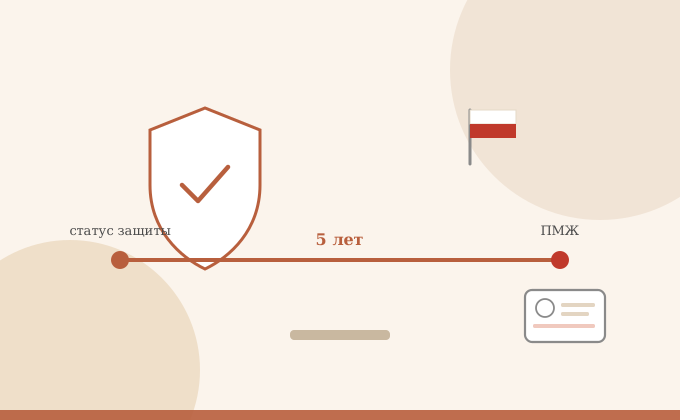
| Pole's Card → permanent residence → citizenship after 1 year — if ancestry can be evidenced, or you have 3 years of activity supporting Polish culture (articles on obtaining the Pole's Card and on permanent residence via the Pole's Card) |
Both are slower than repatriation but considerably faster than the general three-year route: one year to citizenship instead of three, and without proof of income or housing (article on citizenship via permanent residence).
The practical takeaway: start by examining your ancestors' documents — what you can evidence determines which of the three routes is yours.
The territorial condition rules out most enquiries — but for those who pass it, this is the fastest route to citizenship that exists. In a free consultation we'll check both conditions against your documents and, if repatriation isn't your case, identify the alternative.
Frequently asked questions
How does repatriation differ from the Pole's Card in practice? The Pole's Card leads to citizenship via permanent residence plus one further year after it is granted. Repatriation confers citizenship immediately, at the moment of crossing the border on the visa, with no intermediate permanent residence stage and no waiting period.
I'm from Ukraine and have Polish ancestry — does repatriation apply? No. Ukraine is not among the territories where residence before 1 January 2001 gives rise to repatriation rights. You should look instead at permanent residence by Polish origin (article on permanent residence via Polish origin) or the Pole's Card (article on obtaining the Pole's Card).
Does the 3-to-10-year bill apply to repatriation? No. That proposal concerns only recognition as a citizen based on time spent on permanent residence, EU resident status or the right of permanent residence. Repatriation is governed by a separate act and doesn't depend on a residence period.
Can a spouse without Polish ancestry come along? Yes. A visa may be issued to the spouse and to descendants up to the fourth degree of kinship together with their spouses — no Polish ancestry of their own is required. The condition is arrival together with the repatriate and the intention to settle permanently.
Do I need to pass a Polish language exam for repatriation? The B1 certificate required for recognition as a citizen through accumulated residence doesn't apply here — the mechanism for acquiring citizenship is different. Any specific consular requirements should be confirmed with the post handling your case.

Comments