Can you get permanent residence right after the wedding?
No. And this is the first thing people trip over: marriage to a Polish citizen does not by itself give a right to permanent residence — not on the wedding day, and not a year later.
The law requires two conditions simultaneously:
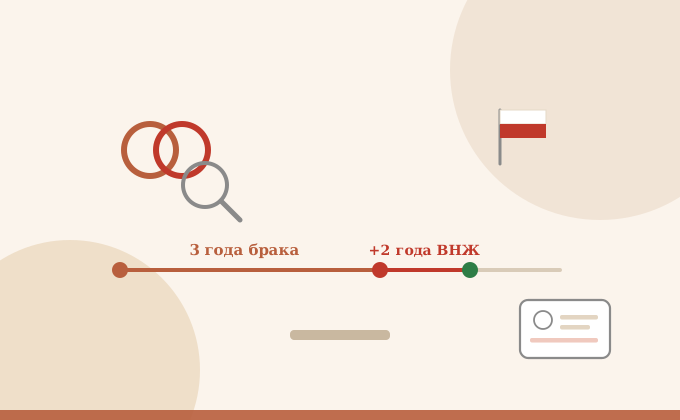
- at least 3 years of marriage recognised under Polish law, as at the date of filing;
- at least 2 years of continuous residence in Poland on a temporary permit issued specifically in connection with that marriage, immediately before filing.
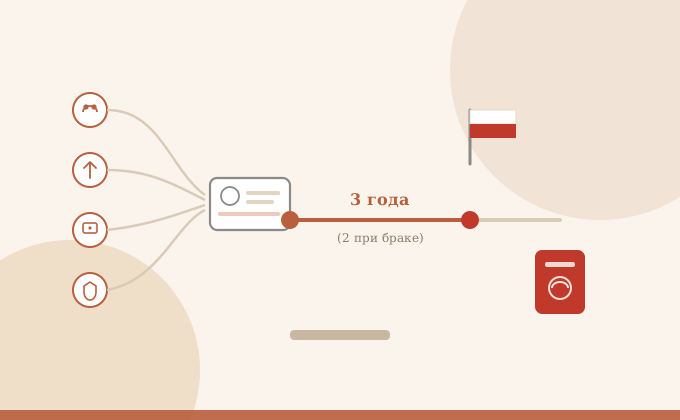
Hence the "3 plus 2" formula: three years of marriage and, within that period, two years on a marriage-based temporary permit. The temporary permit itself is issued for up to 3 years, so the stage can be covered in a single permit — but it has to be covered.
The practical takeaway: temporary permit first, permanent residence second. The stage cannot be skipped.
How long does it actually take?
On top of the years of waiting come the procedures themselves. Here the statutory deadlines and reality diverge noticeably.
| Stage | Statutory deadline | What actually happens |
|---|---|---|
| Decision on the marriage-based temporary permit | 60 days from a complete application with no formal defects and personal appearance | Often around a year until the card is in hand |
| Decision on permanent residence | up to 6 months | Depends on the voivodeship's workload |
That six-month period includes, among other things, a mandatory enquiry by the voivode to the Police, the Border Guard and the Internal Security Agency as to whether the applicant's entry and stay pose a threat to defence, security or public order. Those bodies have up to 30 days to reply, extendable to 60.
Plan against the current workload of your specific voivodeship rather than the statutory deadlines — it varies considerably by region.
Why even a genuine marriage gets checked
The authority handling the case is required to establish whether the marriage was contracted to circumvent immigration law. This isn't an optional formality — it's part of the procedure.
In practice that means: additional evidence of cohabitation may be requested, spouses may be invited to separate interviews, and their accounts compared.
And here's the point people underestimate: a genuine marriage can also fail the check — if the shared life can't be documented. The authority works with evidence, not sincerity. A couple who have lived together for five years but with the flat in one name, the bills in one name and no joint paperwork will objectively look weaker than they should.
Suspicion of a sham marriage is a distinct and common ground for refusal, alongside the broader formulation "well-founded doubts as to the genuineness of the declared purpose of stay" (see article on grounds for refusal on grounds for refusal).
What documents are needed?
- the marriage certificate — in sworn translation if issued abroad;
- proof of identity and a valid marriage-based temporary residence card;
- proof of continuous residence in Poland over the required 2 years;
- documents evidencing cohabitation and a shared household — this is the part most often requested additionally.
Prepare that last item in advance rather than scrambling when asked: a joint tenancy or ownership, joint bills, a joint bank account, insurance policies, correspondence, dated photographs, statements from people who know you. The longer and more consistent the documentary trail, the fewer questions arise.
Marriage is not the fastest route to citizenship
Here a common expectation collides with the arithmetic. Marriage to a Polish citizen intuitively feels like a short route — in practice it's one of the longer ones.
Counting from the point where you have a basis, to citizenship:
| Route | To permanent residence | From permanent residence to citizenship | Total |
|---|---|---|---|
| Marriage | 3 years of marriage + 2 years on a temporary permit | 2 years | roughly 5 years |
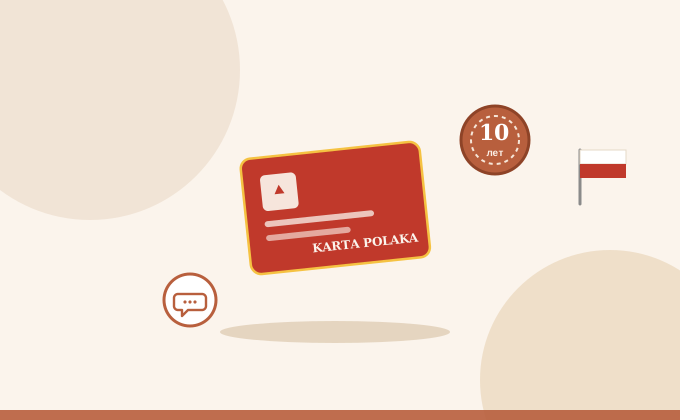
| Polish origin / Pole's Card | no residence period required for the permit itself | 1 year | substantially faster |
| Repatriation | — | citizenship on the day you cross the border | immediate |
So someone with both Polish ancestry and a Polish spouse will most likely reach citizenship faster through ancestry than through marriage. Check for ancestry before building a plan around the marriage — even on thin family leads (articles on permanent residence via Polish origin, on permanent residence via the Pole's Card and on obtaining the Pole's Card).
The flip side: the marriage route requires neither a language certificate for the permit itself, nor proof of income and housing at the citizenship stage — a meaningful concession. If there's no ancestry, it remains one of the most dependable grounds.
What does permanent residence through marriage lead to?
From the moment permanent residence is granted, a separate clock starts toward citizenship, and here a shortened term of 2 years applies instead of the general 3 — provided the marriage to a Polish citizen has lasted at least 3 years at the point of filing.
Additionally, this ground does not require proof of stable income or the right to housing — unlike the general three-year route. The mechanics are covered in article on citizenship via permanent residence.
Refusals on this ground don't only hit sham couples — sometimes genuine ones who simply have nothing to document their shared life with. In a free consultation we'll calculate your timeline under the "3 plus 2" formula and identify what's missing from your evidence.
Frequently asked questions
We married 3 years ago but I only recently moved to Poland — can I apply for permanent residence? No. Beyond the 3 years of marriage there's a separate condition: at least 2 years of continuous residence in Poland on a temporary permit issued in connection with that marriage. Years of marriage spent outside Poland don't count toward that period.
The marriage took place abroad — does it qualify? The marriage must be recognised under Polish law, and the certificate will be needed in sworn translation. Specific situations — particularly marriages contracted in third countries — should be checked individually.
Do I need a Polish language certificate for permanent residence through marriage? Not for the permit itself. It becomes necessary at the next step, when applying for citizenship. Article on the B1 exam covers exactly when the certificate is required.
What evidences cohabitation best? There's no universal list, but the combination works: a shared address across documents, joint contracts and bills, financial traces of a shared household. A single document persuades weakly; a long consistent trail persuades strongly.
We genuinely live together — why all these checks? The check is mandatory under the procedure and is carried out in every case on this ground, not selectively. It doesn't imply suspicion of you personally — but you pass it with documents, not explanations.
Comments