Are EU long-term resident status and permanent residence the same thing?
No. They are two distinct statuses with different grounds, different conditions and different consequences — and they get confused constantly.
| EU long-term resident status | Permanent residence (pobyt stały) | |
|---|---|---|
| Polish name | zezwolenie na pobyt rezydenta długoterminowego UE | zezwolenie na pobyt stały |
| What it's based on | 5 years of residence + income + insurance + B1 | a specific ground: origin, Pole's Card, marriage, protection status, etc. |
| Residence period required | Yes, 5 years | Depends on the ground; for several grounds — no |
| Income required | Yes, over 3 years | For several grounds — no |
| B1 Polish required | Yes | No |
| Recognised in other EU states | Yes, within the directive framework | No, a purely Polish status |
The key practical difference: EU long-term resident status is earned through time — it requires five years, income and language. Permanent residence is granted on a ground: if you have Polish ancestry or a Pole's Card, you don't need to wait five years or pass B1 to get it.
Both statuses then count toward citizenship, but differently — see citizenship via EU resident status and citizenship via permanent residence.
What are the requirements?
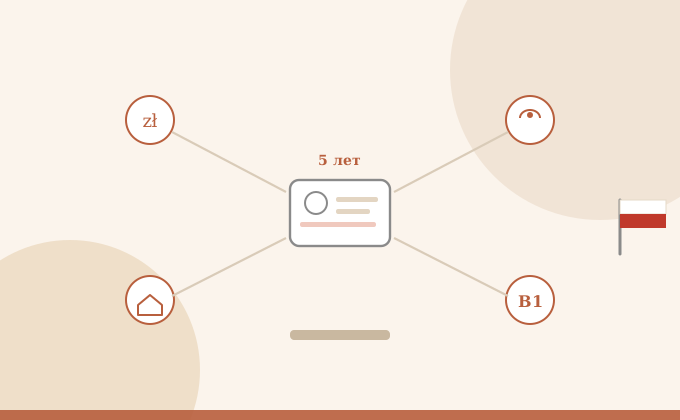
The status is granted to someone who has legally and continuously resided in Poland for at least 5 years immediately before applying, and who simultaneously meets all of the following:
- has a stable and regular source of income sufficient to support themselves and dependent family members;
- has health insurance or confirmation that treatment costs in Poland are covered;
- has confirmed knowledge of Polish at B1 level or above.
One nuance on income: stability is proven over 3 years immediately preceding the application — or over 2 years if the applicant is in Poland on a Blue Card EU (see the article on the Blue Card).
What does this status actually give you elsewhere in the EU?
Expectations here need adjusting. EU long-term resident status does not give freedom of movement comparable to EU citizens.
What it does give: a status recognised in other member states and a facilitated route to obtaining residence rights in another EU country under Directive 2003/109/EC. What it does not give: the ability to simply move and live in another country without approaching its authorities. The destination country will still require a separate procedure and its own conditions, and those requirements differ from state to state.
The framing "EU resident status is basically EU citizenship without the passport" is wrong and leads to unpleasant discoveries at the point of moving. If you're planning to relocate within the EU, check the destination country's conditions separately and in advance.
Who doesn't actually need this status
A non-obvious conclusion worth reaching before you start counting five years.
EU long-term resident status requires five years of residence, three years of proven income and a B1 certificate. That's a substantial investment of time and effort. Meanwhile, permanent residence based on Polish origin or a Pole's Card requires none of it — no five years, no income proof, no language certificate — and from there it's only one year to citizenship instead of three (see the article on citizenship via permanent residence).
In other words: if you have Polish ancestry or grounds for a Pole's Card, aiming for EU long-term resident status may cost you several years for nothing. Check your ancestry before building a five-year plan — documents sometimes turn up where nobody expected them (articles on permanent residence via Polish origin, on permanent residence via the Pole's Card, and on obtaining the Pole's Card).
The flip side: if there's no ancestry and you've already lived in Poland for a few years with steady income, EU long-term resident status is often the most realistic route, precisely because it doesn't depend on marriage, ancestry or protection status.
How and where do you apply?
The application is filed exclusively online through the MOS portal. Logging in requires a PESEL number and either a Trusted Profile or a qualified electronic signature — how to get both is covered in the article on PESEL and Trusted Profile.
The decision is made by the voivode of your place of residence, with up to 6 months for processing. The Office for Foreigners acts as the higher instance and handles appeals, but does not issue the first-instance decision.
An important detail about validity: the decision granting the status is issued indefinitely, while the resident card itself is valid for 5 years. After five years you renew the card, not the status. The status is not lost — these are different things, and they're also frequently confused.
What documents are needed?
- proof of identity;
- proof of continuous legal residence in Poland over the 5-year period;
- income documents for the required period — employment contract, income statements, tax returns, depending on the source;
- proof of valid health insurance;
- a certificate of Polish at B1 or above.
The exact set depends on your income source and the basis of your previous residence.
What does it cost?
| Item | Amount |
|---|---|
| Granting EU long-term resident status | 640 PLN |
| Issuing the card | 100 PLN |
| Issuing a card for a child under 16 | 50 PLN |
EU long-term resident status, permanent residence by ancestry or via a Pole's Card — the routes differ substantially in timelines and requirements, and the right choice isn't always obvious. In a free consultation we'll review your situation and work out which path is shorter.
Frequently asked questions
I had gaps in residence during those 5 years — does that block the application? Short and justified interruptions generally don't break the period, but each situation is assessed individually. Continuity of residence is one of the more common grounds for refusal (see the article on grounds for residence permit refusal).
Do I need B1 for the resident status itself, or only for citizenship? For the status itself. Confirmed Polish at B1 is a separate condition for EU long-term resident status, regardless of whether you later apply for citizenship. Most grounds for permanent residence carry no such requirement.
Can I build up time toward both EU resident status and permanent residence at once? They're two different statuses with different grounds. The residence period accrues for both, but the conditions differ, and it usually makes sense to aim for the one that's achievable faster in your situation.
The card is issued for 5 years — does that mean the status is too? No. The status is indefinite; only the plastic card has an expiry. After 5 years you renew the card and keep the status.
I hold a Blue Card — does that help? In one respect: income stability is proven over 2 years instead of 3. The other conditions — 5 years of residence, insurance, B1 — are the same. More on the Blue Card in a separate article.
Comments