Is three years really enough?
Formally, yes — three years. In practice that figure misleads almost everyone who plans a move around it.
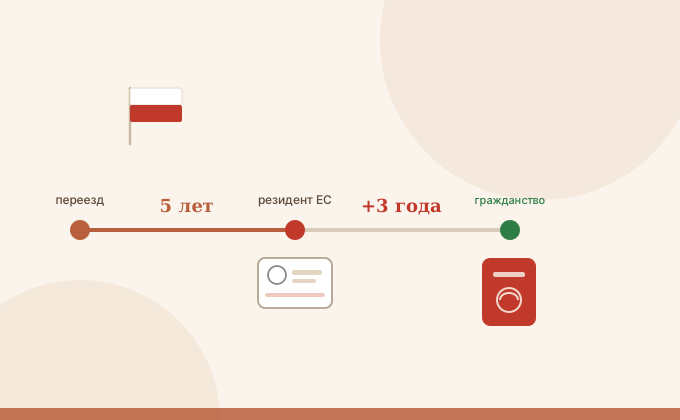
The law (art. 30 ust. 1 pkt 1 of the Polish Citizenship Act) requires 3 years of continuous residence on the basis of EU long-term resident status. The operative words are "on the basis of". The clock starts not on your arrival in Poland, and not with your first residence card, but on the date your EU resident card is issued.
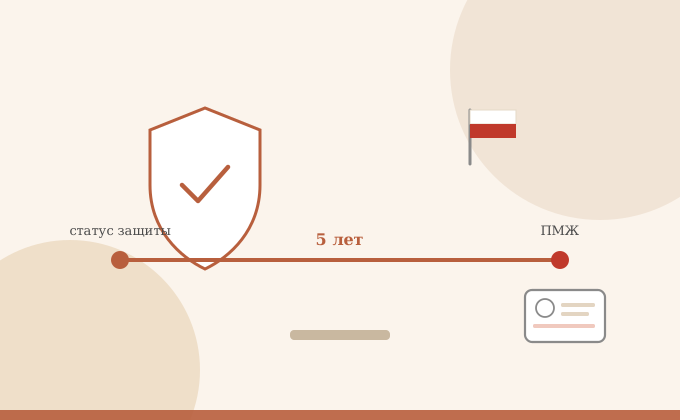
And that status isn't granted from nothing: to obtain it you must already have lived in Poland legally and continuously for at least 5 years (art. 211 ust. 1 of the Foreigners Act).
Which gives the real arithmetic:
| Stage | Period | Provision |
|---|---|---|
| Legal residence before applying for EU resident status | 5 years | art. 211 ust. 1 |
| Residence on EU resident status before applying for citizenship | 3 years | art. 30 ust. 1 pkt 1 |
| Total from relocation to filing | 8 years and up |
And that's the floor, excluding the processing time for the applications themselves — which is considerable, as below.
What grounds exist, and which is faster?
EU resident status doesn't count toward every route to citizenship. These are the ones where it does:
| Ground | Period | Income and housing required? | Provision |
|---|---|---|---|
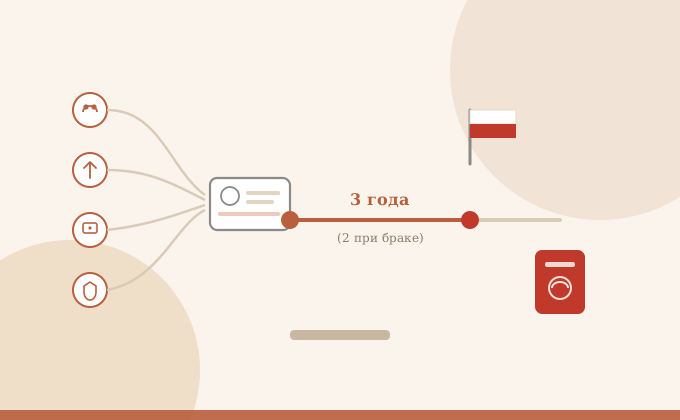
| General route | 3 years on the status | Yes — a stable, regular income and legal title to housing | art. 30 ust. 1 pkt 1 |
| Married to a Polish citizen for at least 3 years | 2 years on the status | No | art. 30 ust. 1 pkt 2 lit. a |
| Holding no citizenship at all | 2 years on the status | No | art. 30 ust. 1 pkt 2 lit. b |
| 10 years of legal residence | see below | Yes | art. 30 ust. 1 pkt 6 |
Look at the third column — this is the detail routinely missed. Pkt 1 expressly requires "stabilne i regularne źródło dochodu oraz tytuł prawny do zajmowania lokalu mieszkalnego". Pkt 2 contains no such requirement at all: it sets only the marriage condition or the statelessness condition. So the two-year marriage route is lighter not just in time but in evidence.
The second thing that gets missed is pkt 2 lit. b: two years on the status also suffices for someone holding no citizenship at all, with no marriage involved. Most overviews don't list this ground separately.
And separately: the shortened routes for refugee status (pkt 3) and for Polish origin or a Pole's Card (pkt 7) count only zezwolenie na pobyt stały. EU resident status doesn't qualify for them — if you have Polish roots or a Pole's Card, you need a different route, via permanent residence, and it's shorter (see the article on the Pole's Card).
What counts as continuous residence?
This condition wrecks more plans than any other, because people learn the rule after the fact.
Art. 30 ust. 3 refers to art. 195 ust. 4 of the Foreigners Act. Residence counts as continuous if:
| Condition | Limit |
|---|---|
| Any single break | no longer than 6 months |
| All breaks combined | no more than 10 months |
Exceeding either limit resets the clock. But four exceptions exist, where a break doesn't count as an interruption:
- performing professional duties or working outside Poland under a contract with an employer whose registered office is in Poland;
- a spouse or minor child accompanying such a person;
- a particular personal situation requiring presence abroad — but no longer than 6 months;
- travel abroad for a placement or classes forming part of a course of study at a Polish university.
The practical upshot: a long stint working abroad doesn't in itself break the clock — but only under a contract with a Polish employer. The same period under a contract with a foreign company does break it.
What you need to prove
| Document | Note |
|---|---|
| Identity document and a valid EU resident card | — |
| Proof of continuous residence on the status for the required period | 3 or 2 years, depending on the ground |
| A stable and regular source of income | Only for pkt 1 and pkt 6 |
| Legal title to housing — ownership, a lease or equivalent | Only for pkt 1 and pkt 6 |
| Proof of Polish language knowledge | See the trap below |
| Marriage certificate with a sworn translation | Only when applying on marriage grounds |
The language trap. Art. 30 ust. 2 accepts three options: an official certificate at B1 or above, a certificate of completing a school in Poland, or a certificate from a foreign school taught in Polish. But ust. 2a states separately that a certificate from a post-secondary school (szkoła policealna) does not evidence language knowledge. People submit one believing the matter settled, and are refused on that point. The exam is covered in detail in a separate article.
The exact list depends on your circumstances and is best confirmed in consultation.
What it costs, and how long it really takes
The fees were raised on 1 August 2025:
| Procedure | Fee |
|---|---|
| Recognition as a Polish citizen (uznanie za obywatela polskiego) | 1,000 PLN |
| Confirmation of holding or losing citizenship | 277 PLN |
| Acceptance of an application for citizenship granted by the President | 1,669 PLN |
That last line is a different procedure — discretionary, and unrelated to time spent on EU resident status. The two are worth keeping apart.
Separately: decisions under art. 30 ust. 1 pkt 4 i 5 — cases involving minor children — are exempt from the fee.
On timing, the law and the practice must be separated. The same amendment extended the statutory processing deadline to 6 months. That's the rule. In practice it runs considerably longer: according to Warsaw legal practitioners, the wait for a decision at the Mazowieckie voivodeship office as of early 2026 was around 15–16 months. That is empirical observation, not a legal norm, and it varies between voivodeships.
On top of that, a separate mechanism suspends the running of deadlines while the office requests documents — covered in the article on the deadline freeze. Plan for a year and a half from filing rather than six months.
When does ten years beat three?
Here is the part of the statute almost nobody discusses — and for some people it decides everything.
Art. 30 ust. 1 pkt 6 provides a separate ground: 10 years of continuous and legal residence in Poland, subject to two conditions at the time of filing — you hold permanent residence, EU resident status or the permanent right of residence, and you have income and housing.
The difference from pkt 1 is subtle but decisive. Pkt 1 counts three years on the basis of the status. Pkt 6 counts ten years of any legal residence — and requires only that you hold the status when you file, with no minimum time on it whatsoever.
Who this helps:
Someone has lived in Poland for 10 years on temporary permits — changing employers, putting off the paperwork, and only now obtaining an EU resident card. Under
pkt 1they face another 3 years, 13 in total. Underpkt 6they can file immediately.
The same applies where time on the status itself was interrupted but overall legal residence was not.
Hence the practical rule: if you've been in Poland a long time but obtained the status late, calculate both grounds, not just the three-year one. The difference can run to several years.
What could change
Two separate documents are under discussion, and they are easily confused.
The presidential bill proposes raising the residence-period requirement — from 3 to 10 years of continuous residence on permanent residence, EU resident status, or the permanent right of residence.
The MSWiA bill is built differently: it changes the structure of the route itself — 8 years in total (3 years of temporary residence plus 5 of permanent), an examination on Polish history and constitutional values, an act of loyalty, and a tax-residency requirement.
Neither bill has been passed or taken effect. The current periods and the B1 requirement still apply. The parliamentary bill on the ten-year period was rejected on 9 January 2026. A detailed status of both is in the overview of all paths to Polish citizenship.
If you're approaching the required period under current rules, it's worth not delaying your documents.
There are several grounds and they're counted differently: three years on the status in one, ten years of any legal residence in another, and in some, income and housing aren't required at all. In a free consultation we'll calculate your time under every ground that fits and tell you which one serves you best.
Frequently asked questions
From what date do the three years run? From the date your EU resident card is issued — not from your arrival in Poland, and not from your first residence card. This is the most common error in do-it-yourself calculations.
Can I speed up obtaining EU resident status itself?
The five-year period can't be shortened — it's a statutory minimum under art. 211 ust. 1. One thing you can genuinely speed up: not delaying the application once the five years are complete. Bear in mind, too, that income for the status is evidenced going back 3 years (art. 211 ust. 2), so it can't be tidied up retroactively.
I was outside Poland for six months. Have I lost the time?
It depends how. The limits are no single break longer than 6 months and no more than 10 months combined. Exactly six months falls within the limit. But if there were several trips, the total counts too. The exceptions are work abroad under a contract with a Polish employer, plus three further cases in art. 195 ust. 4.
Do I need income and housing if I'm married to a Polish citizen?
No. Art. 30 ust. 1 pkt 2 contains no such conditions — only the requirement of at least 3 years of marriage and 2 years on the status. The income and housing requirement sits in pkt 1 and pkt 6.
I have a Pole's Card. Do I also need these 8 years?
No, and this matters: the shortened route under pkt 7 — one year — counts only permanent residence, and EU resident status doesn't qualify for it. If you hold a Pole's Card or documented Polish origin, your route runs through permanent residence, not EU resident status. See the article on the Pole's Card.
Is it true that after the reform a test alone will be enough, without a residence requirement? No — the bills under discussion move in the opposite direction: more years of residence, and under the MSWiA bill additionally an examination on history and constitutional values, an act of loyalty, and tax residency.

Comments